
Build for Less: House Plans That Are Inexpensive to Build
The secret to finding house plans that are inexpensive to build really boils down to one word: simplicity. The smartest, most cost-effective homes I’ve seen all share a few key traits. They have a straightforward architectural footprint, a highly efficient interior layout that maximizes every inch of space, and a budget-conscious approach to materials.
These three principles aren't just separate ideas; they work together from day one to drive down both labor and material costs.
The Blueprint for Building on a Budget
Building an affordable home starts way before anyone swings a hammer. The real key to making your dream home a reality—without jeopardizing your finances—is making strategic decisions from the outset. Think of it as creating a financial roadmap for your build before it even begins.
This guide is designed to debunk the myth that "affordable" means "low-quality." It doesn’t. Instead, we'll explore how smart, intentional planning is the foundation of any successful, budget-friendly project.
We'll focus on three core principles that have the biggest impact:
Simple Architectural Footprint: Minimizing corners and complex rooflines is one of the most effective ways to reduce labor time and material waste.
Efficient Interior Layout: By maximizing every square foot with open concepts and multi-functional spaces, you eliminate the cost of building unnecessary rooms or hallways.
Smart Material Selections: Choosing standard-sized, readily available, and durable materials helps you avoid the budget overruns that sink so many projects.
Prioritizing Core Cost-Saving Strategies
Embracing a "less is more" philosophy is absolutely central to building affordably. In the United States, economic pressures have led to a shift towards smaller, more efficient home designs. It’s a trend we’re seeing everywhere.
In fact, the median size of new single-family homes has dropped to its lowest point in over a decade. This isn't just a style choice; it's a direct response to building costs. Smaller homes require fewer materials and less labor—it's that simple. You can dive deeper into these home size trends with data from the National Association of Home Builders (NAHB).
By focusing on what truly matters—a strong structure, a functional layout, and durable finishes—you can build a beautiful home that respects your budget. The goal is intentional design, not compromise.
To help you get a clear picture of how these ideas work in practice, I’ve compiled a brief table. It breaks down these foundational concepts and shows you how they impact your overall building costs.
Core Principles of Inexpensive House Plans
This table summarizes the fundamental strategies for reducing home construction costs through smart planning and design.
Principle | Description | Estimated Cost Impact |
|---|---|---|
Simple Footprint | A rectangular or square foundation with 4-6 corners is far cheaper to build than a complex shape with numerous jogs and angles. | 10-15% reduction in framing and foundation costs. |
Standard Dimensions | Designing rooms and layouts to use standard lumber lengths (e.g., 8, 12, 16 feet) and material sizes (e.g., 4x8 drywall sheets) minimizes cutting and waste. | 5-10% reduction in material costs. |
Simple Roof Design | A gable or hip roof is significantly less expensive than a roof with multiple valleys, dormers, and intersecting planes. | 15-20% reduction in roofing labor and material costs. |
Efficient Layout | An open-concept plan that combines living spaces and "stacks" plumbing (kitchens and bathrooms back-to-back or above/below each other) reduces material and labor costs. | 5-10% reduction in plumbing and interior framing costs. |
Understanding these elements gives you the power to identify and prioritize the features that will save you the most money. It’s all about ensuring your new home is both beautiful and truly budget-friendly.
How Simple Shapes Save You Serious Money
When considering house plans that are inexpensive to build, the single biggest factor that will impact your budget is the shape of the home. Every extra corner, jog, and complicated roofline adds a surprising amount of cost, complexity, and time to your project. It’s a basic rule of thumb in construction: simplicity saves money.
Think of it this way: a simple rectangular house is like putting together a basic, four-cornered box. The process is direct, uses standard cuts of lumber, and creates minimal waste. Now, imagine a house with multiple gables, little bump-outs, and bay windows. That's a complicated puzzle, and every custom-cut piece requires more labor, skill, and materials to get it right.
This diagram illustrates how a home's footprint, layout, and materials are all interconnected in terms of cost.
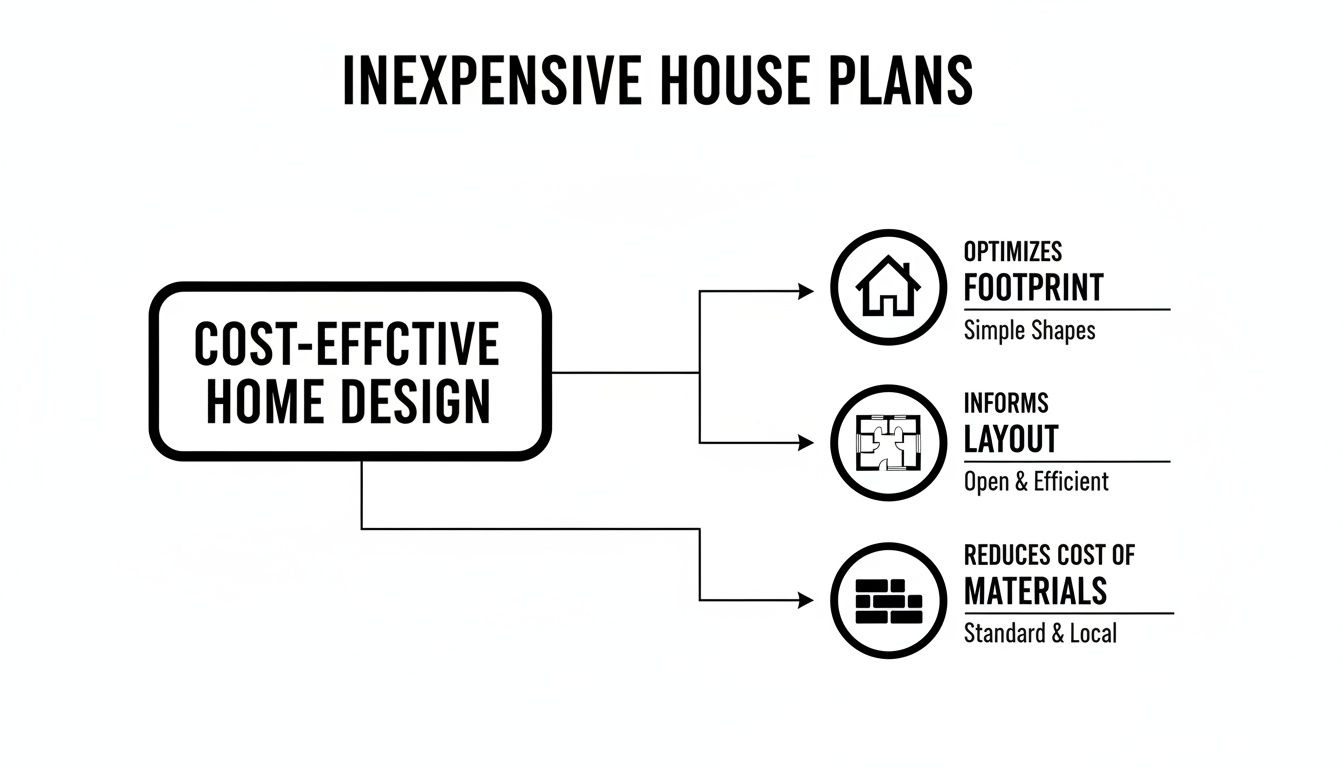
As you can see, a simple footprint is the foundation (literally!) of an affordable build. It directly impacts how efficient your layout can be and how many materials you'll need.
The True Cost of Complexity
The financial penalties for a complex design really stack up at every stage of the build. Choosing a simple, four-corner footprint is almost always the most budget-friendly option because it makes the most expensive parts of construction so much easier.
Here’s where a simple shape really saves you money:
Foundation: Pouring a straightforward rectangular slab or digging a square basement is far cheaper than forming a foundation with tons of corners and angles. That complex formwork requires a significant amount of time and labor.
Framing: A simple shape allows builders to use standard lumber lengths with minimal cutting. This significantly reduces both material waste and labor hours. Every extra corner makes framing and sheathing more complicated.
Roofing: A simple gable or hip roof costs dramatically less than a roof with multiple valleys, dormers, and intersecting planes. Complex roofs require more materials, additional flashing, and more skilled (and expensive) labor to ensure they don't leak.
Finishing: Installing siding, hanging drywall, and laying flooring is much faster and creates less waste on simple, flat walls compared to surfaces with complex shapes and contours.
A study on construction costs found that adding corners beyond the basic four can bump up framing expenses by 10-15%. It also makes roofing significantly more complex, driving those costs even higher.
Spotting Cost-Adding Features in a Plan
When you're browsing through house plans, train your eye to look for clean, simple lines. There's a reason architects and savvy builders almost always favor these designs when budgets are tight. Learning to spot these cost-adding features will help you make a smart financial choice right from the start.
Keep an eye out for these red flags:
Excessive Corners: Count the number of outside corners on the floor plan. If you see more than six, that should give you pause if affordability is your main goal.
Intricate Rooflines: Look for multiple gables, dormers, or a bunch of different roof pitches. A simple, unified roof is always more cost-effective.
Jogs and Bump-Outs: Those small extensions for a breakfast nook or a window seat add a lot of cost for very little functional square footage.
By prioritizing a simple shape, you lay a foundation for savings that will benefit you through the entire build. It’s proof that great design doesn’t have to be complicated or expensive.
Maximizing Every Square Foot With an Efficient Layout
Building an inexpensive home isn't about giving up space; it's about being smarter with the space you have. Once you’ve settled on a simple footprint, the real savings start to accumulate within. A truly efficient layout ensures that every single square foot has a purpose.
This is the magic of good design: making a smaller, more affordable home feel generous, open, and incredibly functional.
The go-to strategy here is the open-concept layout. By merging the kitchen, dining, and living areas into one large, open space, you instantly eliminate a number of interior walls. That one move alone reduces framing, drywall, and painting costs, giving your budget some breathing room while making the whole home feel connected and airy.

It also prompts you to consider how rooms can serve multiple purposes—another valuable secret weapon in budget-friendly home design.
Designing for Multi-Functional Living
Wasted space is just wasted money. Think about long, empty hallways. You pay to build them, heat them, and cool them, but you can't live in them. The whole point of an efficient plan is to identify and utilize these underutilized areas, maximizing their potential.
This is where you get creative with rooms that can pull double duty. A smart, cost-effective plan might feature:
A mudroom and laundry room combo located right off the garage.
A home office nook tucked into a corner of the living room or a wide spot in a hallway.
A guest room that doubles as a comfortable den or a hobby space when you don't have company.
By combining functions like this, you get more out of a smaller home. That’s the ultimate win when you're trying to build affordably.
“Simple floor plans with basic shapes are less expensive than elaborate ones. The key is to reduce wasted space like long hallways and create an effortless flow between main living areas, making the home feel larger than it is.”
This same common-sense approach also applies to living areas. It's also a game-changer for the guts of the house.
Stacking Utilities for Major Savings
Here’s one of the most powerful, yet often overlooked, strategies in house plans that are inexpensive to build: "stacking" your plumbing. It’s a simple concept. You design the layout so the kitchen, bathrooms, and laundry room are all clustered together.
They can be back-to-back on a single floor or stacked right on top of each other in a two-story home.
This clever alignment drastically reduces the length of pipes for water and drains. It also means less wiring for electrical and shorter runs for HVAC ducts. Shorter runs mean fewer materials and less time for your trades to do the installation. This single design choice can save you thousands on some of the priciest parts of construction. When every dollar counts, a smart layout is your best friend.
Choosing Building Materials That Work for Your Budget
The materials you choose are quite literally the building blocks of your home—and your budget. When you're looking at house plans that are inexpensive to build, the secret isn't just picking the cheapest items off the shelf. It's about looking at the bigger picture: the total cost of ownership. This includes the sticker price, the amount of labor required for installation, and the potential maintenance costs down the road.
Making smart choices here means you won't trade a small upfront saving for a huge headache later on. For instance, some cheaper materials may require a highly skilled (and more expensive) crew to install them correctly, or they may need frequent repairs, completely erasing the initial budget advantage. A little homework now can pay you back for decades.
This is where you can start having confident, cost-saving talks with your builder. For more ideas on this topic, check out our guide on reducing construction costs.
Balancing Upfront Costs and Long Term Value
When weighing your material options, consider the entire system. Your home's foundation, siding, and roof are three of the biggest-ticket items, and each one is a prime opportunity to save money. A slab-on-grade foundation, for example, is almost always cheaper than digging out a full basement, potentially saving you anywhere from $10,000 to $30,000.
Vinyl siding is another popular, budget-friendly option because it's easy to install. On the other hand, fiber cement siding costs more upfront but offers incredible durability. Efficiency matters, too. Think about how townhomes save a bundle with shared walls—that simple design choice can cut down on lumber, siding, and insulation by as much as 25% compared to two separate houses.
The best budget-friendly material hits that sweet spot: an affordable initial cost, reasonable installation labor, and low long-term maintenance. Durability isn't just a feature; it's a huge part of the value equation.
The roof is a perfect example. Understanding the cost of a new roof is a crucial piece of the puzzle. Asphalt shingles are the standard for affordability, but a metal roof, while initially more expensive, can last twice as long with minimal upkeep.
Building Material Cost and Value Comparison
To help you make these tough calls, we've put together a quick comparison of common building materials. This table lays out the initial cost, installation complexity, and long-term maintenance needs to guide your budget-conscious decisions.
Component | Budget-Friendly Option | Mid-Range Option | Key Considerations |
|---|---|---|---|
Foundation | Poured concrete slab | Crawl space | A slab is the most affordable option, but it offers no under-house storage or access. A crawl space adds cost but simplifies plumbing and electrical access. |
Exterior Siding | Vinyl | Fiber Cement | Vinyl is low-cost and low-maintenance but can be damaged. Fiber cement is more durable and fire-resistant but costs more to buy and install. |
Roofing | Asphalt Shingles | Metal Roofing | Asphalt is an affordable and easy-to-install material. Metal offers superior longevity and energy efficiency but has a higher upfront cost. |
Comparing these options side by side helps clarify where your money is really going, both today and ten years from now.
Finally, one of the easiest ways to keep material costs in check is to stick with standard sizes simply. Custom-ordered windows and doors come with a serious price premium. Designing your home around common, off-the-shelf sizes for everything from doors and windows to bathtubs will significantly reduce your material expenses and help you avoid frustrating delays.
Inspiring Examples of Affordable Home Designs
Discussing simple shapes and smart layouts is one thing, but seeing these ideas come to life is what truly sparks inspiration. Sometimes, the best way to understand how to build affordably is to examine home styles that have perfected the concept for decades.
You’ll find that building an attainable, beautiful home doesn't mean you have to sacrifice style. Far from it.

Classic and Cost-Effective Styles
Certain architectural styles have stood the test of time for a very simple reason: they’re practical to build. Their very nature embodies the cost-saving principles we've been talking about.
Here are a few classic examples that make sense from a budget perspective:
Simple Ranch Homes: The single-story ranch is the undisputed champion of affordable construction. Its straightforward rectangular footprint keeps foundation and roofing costs in check, while the absence of stairs cuts a major construction expense and creates an open, accessible flow.
Classic A-Frames: An A-frame's iconic shape is pure efficiency. The steep roof pulls double duty as the walls, which dramatically slashes the need for complex framing and expensive siding. It’s a genius design for a budget-friendly cabin or a striking small home.
Modern Barndominiums: "Barndos" have exploded in popularity, and for good reason. They are typically built using a simple metal frame and siding—a large, rectangular shell that houses a wide-open interior. This approach keeps both material and labor costs down.
These styles are a fantastic jumping-off point. You can find more cost-effective house plans for your dream home to see how these ideas are put into practice across various design styles.
The Tiny Home Movement: A Case Study
Of course, no conversation about inexpensive building is complete without mentioning the tiny home movement. It’s the ultimate case study in saving money by rethinking your footprint entirely.
This global trend is all about building for less by going small. Homes under 400 square feet can slash total construction costs by 50-70% compared to a standard new build. It’s a powerful financial move, with mortgages that are just a fraction of a traditional home loan. For a deeper dive, you can find more tiny house statistics on TinyHousePlans.com.
By focusing on what is truly essential, tiny homes maximize every inch of space and minimize material waste. They prove that thoughtful design, not square footage, is what makes a house a home.
Even if you have no plans to live in a tiny house, the lesson here is powerful. The most direct way to reduce your budget is to decrease your home’s overall size. It impacts everything from the foundation pour to the final coat of paint, and it continues to save you money down the line on utilities and maintenance.
Budgeting and Planning for Your Build
Picking an inexpensive house plan is a great start, but disciplined financial planning is what truly gets you across the finish line. Even the most brilliant design on paper can quickly morph into a budget nightmare without a solid framework for managing every dollar you spend.
The first step is understanding where your money is going. Think of your budget in two main categories. Hard costs encompass all the tangible elements—the lumber, the concrete, and the skilled crews that put it all together. Then you have the soft costs, which are the less visible but equally critical expenses, such as design fees, land surveys, and building permits.
Creating a Financial Safety Net
One of the biggest mistakes I see people make is not planning for the unexpected. That’s why a contingency fund isn’t just a nice-to-have; it’s an absolute must. Trust me, things happen. Weather delays, a sudden spike in material prices, or a surprise issue with your site can throw a wrench in the works.
A good rule of thumb is to set aside 10-15% of your total construction budget for a contingency fund. This creates a financial buffer to handle those curveballs without derailing the whole project.
This single step can be the difference between a build filled with stress and one that’s successful and even enjoyable. For a more structured approach, exploring different home construction budget template options for 2025 will provide you with the tools to track every single expense.
Vetting Contractors and Getting Accurate Bids
Think of your general contractor as your most important partner in this whole process. They’re the ones who will keep your project on track and on budget, so vetting them properly is essential. Always get at least three comprehensive bids from reputable builders. This lets you compare not just the bottom-line number, but the entire scope of work they’re including.
When you're looking over those bids, keep an eye out for a few red flags:
Vague Allowances: If a bid has unclear or suspiciously low allowances for finishes, such as flooring or countertops, it may be a way to conceal future costs that will arise later.
Lack of Detail: A professional, trustworthy bid should be itemized. You want to see a clear breakdown of where your money is going.
Unusually Low Prices: An offer that seems too good to be true usually is. It could be a sign of cut corners, cheap materials, or a plan to hit you with a lot of change orders down the road.
For unparalleled accuracy in cost estimation, particularly when working with affordable house plans, consider engaging professional quantity surveying services. Having this level of financial insight arms you with the confidence you need to navigate the building process from start to finish.
Frequently Asked Questions About Affordable Home Building
Building a new home is an exciting process, but it's natural to have questions, especially when it comes to the budget. We've compiled some of the most frequently asked questions we receive from homeowners to help you gain a clearer understanding of how to build affordably.
What Is the Cheapest Type of House to Build Per Square Foot?
Generally speaking, the simplest designs tend to be the least expensive. A single-story, rectangular home—think of a classic ranch style—built on a slab foundation is usually the most budget-friendly option. This approach sidesteps the costs that come with complex foundation work, intricate rooflines, and multi-level framing.
An open-concept layout also helps keep costs down. By removing the need for numerous interior walls, you save a significant amount on both materials and the labor required to build them.
Can I Really Save Money by Building a Smaller House?
Absolutely. This is the single biggest lever you can pull to control costs. Every square foot you decide you don't need saves you money on practically everything—foundation, framing, drywall, flooring, paint, and roofing.
And the savings don't stop once the house is built. A smaller home means lower utility bills, property taxes, and maintenance costs for years to come.
While a larger house has a higher total price tag, it often has a lower cost per square foot. But don't let that metric fool you; the overall budget will always be higher for a bigger home.
Are Two-Story Houses Cheaper to Build Than One-Story Houses?
This one is a classic "it depends" scenario, and it really comes down to size. For the same total square footage, a two-story home has a smaller—and therefore cheaper—foundation and roof.
However, you're introducing new costs. You'll need stairs, more complex framing to support the second floor, and potentially longer runs for your plumbing and HVAC systems. For smaller homes, say under 1,500 sq ft, a single-story design is often the more economical choice. As you move into larger homes, the two-story plan can become more financially viable.
Ready to find a plan that fits your vision and your budget? At RBA Home Plans, we specialize in beautiful, construction-ready designs that are both stylish and affordable to build. Explore our collection of home plans and find the perfect blueprint for your dream home.


Helpful ideas for budget-friendly construction. Affordable Building Permit Plans ( Plan Permis De Construire Pas Cher ) are a great way to start planning efficiently.