
Second Home Tax Deductions: Your Guide to Bigger Savings
Updated: Feb 3
Absolutely. That second home—whether it's a mountain cabin or a beachside cottage—can come with some pretty significant tax breaks. The trick is knowing which ones you can actually claim. It all boils down to how you use the property: is it your personal getaway, a source of rental income, or a little bit of both?
Your Roadmap to Second Home Tax Savings

Think of your second home as a unique financial asset that plays by its own set of rules. The IRS is very specific about how it classifies these properties based on your personal and rental use, creating three distinct paths for tax deductions. This guide is your map to navigating those paths and making a smart investment even smarter.
To get started, it’s a good idea to familiarize yourself with the various short-term rental tax deduction strategies out there. Figuring out how your property is classified is the very first step.
Classifying Your Second Home for Tax Purposes
How the IRS sees your second home is the foundation of your entire tax strategy. Getting this right is critical, as it dictates everything from whether you can write off mortgage interest to how you claim rental expenses.
There are three main ways your property can be classified:
Personal Residence: This is your spot if you use the home for yourself and rent it out for 14 days or less during the year. You can deduct mortgage interest and property taxes, but you can't write off any rental-related costs.
Mixed-Use Property: This category applies if you rent the home for more than 14 days and use it personally for more than 14 days (or more than 10% of the total days it was rented). For these properties, you’ll have to carefully split your expenses between personal and rental use.
Rental Property: If your personal use is minimal—14 days or less, or under 10% of the rental days—the IRS sees it as a rental property. This classification opens up a much wider range of business-style deductions, which can be a huge advantage.
Understanding these categories is non-negotiable for maximizing your tax benefits. Misclassifying your property is a common and costly mistake that can lead to missed deductions or IRS scrutiny.
To help you see the big picture, here’s a quick summary of the deductions available for each use case.
Second Home Tax Deductions At a Glance
This table breaks down the main tax benefits, what they cover, and the most important rules to keep in mind.
Deduction Type | What It Covers | Key Limitation or Rule |
|---|---|---|
Mortgage Interest | Interest paid on the loan used to buy the home. | Total debt for all homes can't exceed $750,000. Applies to personal and mixed-use properties. |
Property Taxes | State and local property taxes paid on the home. | Capped at $10,000 per year for all state and local taxes combined (the SALT cap). Applies to all property types. |
Rental Expenses | Costs like insurance, utilities, and repairs. | Only deductible for mixed-use and rental properties. Must be prorated based on rental vs. personal use days. |
Depreciation | The "wear and tear" on the property over time. | Only available for rental properties. You can't depreciate the land, only the structure itself. |
Casualty Losses | Damage from sudden, unexpected events (e.g., storms). | Must occur in a federally declared disaster area. The loss must exceed 10% of your adjusted gross income (AGI). |
This is just a starting point, of course. Each deduction has its own set of specific rules and nuances you'll need to follow.
Navigating these rules correctly ensures you can fully benefit from major deductions, such as mortgage interest and property taxes. If you're just starting your journey, our guide on financing a second home offers practical advice on securing the right loan. We'll walk through the specifics for each scenario to give you a clear overview of the financial advantages available.
The Mortgage Interest Deduction on a Second Home
Of all the financial perks that come with owning a second home, the Mortgage Interest Deduction (MID) is often the biggest. Think of it as a direct reward for your investment.
Every month, a chunk of your mortgage payment goes toward interest. This deduction lets you subtract that amount from your taxable income, potentially saving you thousands of dollars each year. It’s a powerful benefit that applies to your primary residence and your second home, as long as you play by the IRS rules.
Understanding the Debt Limits
The first major rule to get your head around is the total debt limit. This is a crucial point many new owners miss: the IRS combines the mortgage balances from both your primary and second homes to see if you qualify.
You can deduct the interest on up to $750,000 of total mortgage debt across both properties. This limit is for homes purchased after December 15, 2017. If you're married but filing separately, this limit is cut in half to $375,000.
For example, say your primary home has a $500,000 mortgage and your new vacation cottage has a $250,000 mortgage. Your total debt is $750,000, so you can deduct all the interest you pay on both loans. But if that second home mortgage was $300,000, your total debt would be $800,000. You could only deduct the interest on the first $750,000.
This is a powerful tool, especially for those in higher tax brackets. In fact, the Joint Committee on Taxation estimates the MID will reduce federal revenue by $26 billion in fiscal year 2025 alone. Research from the Bipartisan Policy Center shows that households earning over $150,000 account for 64% of these returns, making this a significant benefit for affluent vacation homeowners. You can dig deeper into their explainer on second home tax reform options.
Qualifying Your Home and Loan
Beyond the debt limit, both your home and the loan must meet specific IRS criteria. The rules are straightforward but absolute.
First, the loan must be secured. This just means your second home acts as collateral for the loan, which is standard for most traditional mortgages. Unsecured personal loans you might use for a down payment won't count.
Second, the property itself must be a "qualified home," which simply means it has basic living accommodations. This includes:
Sleeping space (a bedroom)
Cooking facilities (a kitchen)
A toilet (a bathroom)
This definition is pretty broad. It covers houses, condos, co-ops, mobile homes, and even boats, as long as they have these three features. If you're just starting your search, our guide to second home mortgage rates for property buyers can help you explore your financing options.
The Impact of Rental Use
How you use your second home also plays a critical role. If you only use it for personal enjoyment and never rent it out, you can deduct your mortgage interest without any extra headaches. Simple.
But if you do rent it out, you have to meet a minimum personal use requirement to keep it classified as a second home for this deduction. You must personally use the home for more than 14 days or more than 10% of the days it was rented to others—whichever is longer.
If your personal use dips below this threshold, the IRS reclassifies the property as a rental business, and the rules change completely. In that case, your mortgage interest becomes a business expense deducted on Schedule E, not an itemized deduction on Schedule A.
Maximizing Property Tax and SALT Deductions
After your mortgage, property taxes are easily one of the biggest ongoing expenses of owning a second home. The good news? Those taxes are usually deductible, which gives you another fantastic way to lower your tax bill. This deduction, however, falls under the State and Local Tax (SALT) deduction.
It helps to think of the SALT deduction as a single bucket you can fill with the different state and local taxes you pay throughout the year. This bucket includes property taxes on your primary and second homes, plus either your state income taxes or your state sales taxes — you get to pick whichever one is higher.
For the last few years, that bucket has had a pretty tight lid, capping how much you could deduct. This often meant that folks in high-tax states couldn't get the full benefit from the property taxes they paid on multiple homes. But that's all about to change, and it’s a huge new advantage for second-home buyers.
Navigating the SALT Deduction Cap
The secret to making this deduction work for you is understanding the cap. The previous limit was pretty restrictive and often stopped homeowners from deducting their full property tax bill, especially if they owned more than one property in states like New York, New Jersey, or California.
Thankfully, that’s changing in a big way. For tax years 2025-2029, the SALT cap is scheduled to jump from a mere $10,000 to a much more substantial $40,000 for joint filers ($20,000 if you file separately). This single change could unlock tens of thousands more in property tax deductions, taking a real financial sting out of owning that dream home, whether it’s a coastal getaway or a modern craftsman design. As you can discover more about second home tax benefits, this expanded cap covers all your properties, as long as you itemize.
To grab this benefit, you absolutely have to itemize your deductions on Schedule A of your Form 1040. Don't take the standard deduction. For most homeowners, the combination of mortgage interest and SALT deductions will easily sail past the standard deduction, making itemizing the obvious financial move.
A Practical Example of the New SALT Cap
Let's break this down with a real-world scenario. Imagine the Martins, a family who are building their dream craftsman-style second home.
Primary Home Property Taxes: $15,000
Second Home Property Taxes: $10,000
State Income Taxes: $20,000
Under the old $10,000 SALT cap, the Martins could only deduct a small portion of their total state and local taxes. Even though they paid a whopping $45,000 in combined taxes, their deduction was stuck at just $10,000.
Now, let's fast-forward to the new $40,000 cap. The Martins can add up their property taxes ($15,000 + $10,000 = $25,000) and their state income taxes ($20,000). They can deduct the full $25,000 in property taxes and then add another $15,000 to their state income taxes, hitting the $40,000 ceiling.
This strategic shift from a $10,000 deduction to a $40,000 deduction directly translates into a much lower taxable income for the Martins, potentially saving them thousands of dollars.
Who Qualifies for the Property Tax Deduction
The rules for deducting property taxes on a second home are pretty straightforward. Unlike the mortgage interest deduction, which has some specific rules about personal use, the property tax deduction is available for any second home you own, as long as it's mainly for your personal enjoyment.
Here’s a quick rundown of what you need to know:
Itemize Your Deductions: This is non-negotiable. You can't claim the SALT deduction if you take the standard deduction. Simple as that.
Taxes Must Be Paid: You can only deduct taxes in the year you actually pay them. If your lender pays your taxes through an escrow account, you get to deduct the amount they paid on your behalf during the year.
No Per-Property Limit: The SALT cap applies to your entire tax return, not to each house. This is great because it means you can lump together the property taxes from your primary and second homes to get the biggest bang for your buck.
Navigating Rental Income and Expense Rules
When your second home starts bringing in rental income, it stops being just a simple getaway. In the eyes of the IRS, it’s now a hybrid asset: part personal retreat, part business. This adds a new layer to your tax planning, but it also unlocks powerful deductions for maintenance, utilities, and even depreciation. The trick is knowing how to classify your property correctly based on how much you rent it out versus how much you use it yourself.
The whole game plan hinges on one critical threshold: the 14-day rule. This simple guideline is a fork in the road that determines how you report your income and which expenses you can claim. Crossing this line can change your property from a personal residence with a little side income to a full-blown rental business for tax purposes.
The 14-Day Rule Deconstructed
Think of the 14-day rule as the first and most important decision point for your second home's tax strategy.
If you rent your second home for 14 days or less during the year, the IRS gives you a surprisingly sweet deal. You don't have to report any of that rental income. It's essentially tax-free cash. The trade-off? You can't deduct any expenses associated with renting it, such as cleaning fees or agent commissions. You can still, however, claim your usual mortgage interest and property tax deductions, assuming you itemize.
The moment you rent the property for 15 days or more, you've crossed the line. From this point on, you must report all your rental income. The good news is this also opens the door to deducting a whole host of expenses tied to that rental activity, which we’ll get into next.
Allocating Expenses Between Personal and Rental Use
So, what happens when your property is in that mixed-use category—rented for more than 14 days and also used personally for more than 14 days (or 10% of the total rental days)? You can’t just write off 100% of your utility bills or insurance premiums. The IRS requires you to split these costs between personal and rental use.
Here’s the simple math for it:
Count Total Days of Use: Add up the total number of days you rented the property at a fair market price and the days you used it yourself.
Figure Out the Rental-Use Percentage: Divide the number of rental days by the total days of use from step one.
Apply the Percentage: Multiply your total indirect expenses (like mortgage interest, insurance, and utilities) by this percentage. That final number is the amount you can deduct as a rental expense on Schedule E.
Let's say you rent your beach cottage for 90 days and use it personally for 30 days. Your total usage is 120 days. Your rental-use percentage is 75% (90/120). That means you can deduct 75% of your relevant expenses against your rental income.
Building a beautiful and profitable vacation spot can be simpler than you think; for some great starting points, check out these inspiring house plans for vacation homes.
Direct vs. Indirect Rental Expenses
To really get the most out of your deductions, it's important to know the difference between the two types of rental expenses.
Direct Expenses: These are costs that apply only to the rental activity. Think advertising fees, commissions paid to a rental agent, or the cost of a credit check on a potential tenant. You can deduct 100% of these costs.
Indirect Expenses: These are the costs of simply owning and maintaining the home all year, whether it's rented or empty. This bucket includes mortgage interest, property taxes, insurance, utilities, and general upkeep. These are the expenses that you have to split based on your rental-use percentage.
If your property is a mix of personal and rental, you’ll have to make some clear distinctions. The table below breaks down how the rules shift based on your rental activity.
Rental vs. Personal Use Tax Rules
Usage Scenario | Rental Days | Personal Use Days | Deductible Expenses |
|---|---|---|---|
Primarily Personal | 14 or fewer | Any | Mortgage interest and property taxes are deductible (subject to SALT limits). Rental income is tax-free, but no rental expenses can be deducted. |
Mixed-Use | 15 or more | More than 14 days or >10% of rental days | All rental income must be reported. Expenses must be allocated between personal and rental use. Rental expense deductions cannot exceed rental income (no loss allowed). |
Primarily Rental | 15 or more | 14 or fewer (or <10% of rental days) | All rental income must be reported. Expenses are allocated, but you can deduct rental expenses that exceed rental income, creating a taxable loss (subject to passive activity loss rules). |
This table shows just how critical it is to track your days of use. Crossing from one category to another completely changes your tax obligations and opportunities.
This visual helps explain the thought process behind deciding whether to itemize deductions, the first step toward claiming deductions like the SALT cap.
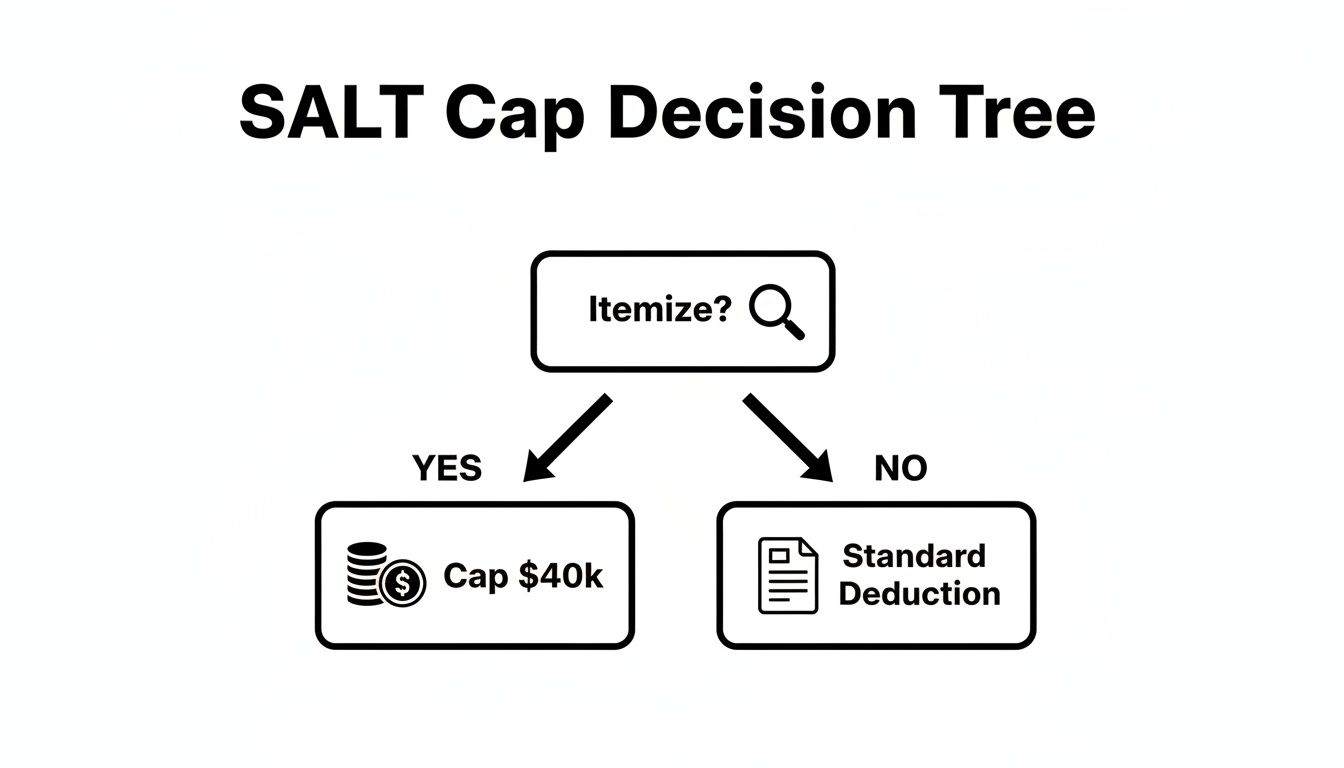
The big takeaway here is that choosing to itemize is what unlocks major tax savings from property ownership, which leads right into navigating the SALT cap.
Important Takeaway: Meticulous record-keeping is your absolute best friend. Keep a detailed, separate log of all rental days, personal use days, and every dollar of income and expense. This paperwork is your proof if the IRS ever comes knocking.
Ultimately, renting out your second home can be a great way to generate income while enjoying some significant tax benefits. As long as you understand the 14-day rule and allocate your expenses properly, you can maximize your financial return and stay on the right side of the IRS.
Other Important Deductions and Casualty Losses
Beyond the big two—mortgage interest and property taxes—a few other valuable tax deductions for your second home often fly under the radar. It's easy to miss them, but they can make a real difference, especially when you’re dealing with loan costs or the unfortunate aftermath of a natural disaster. Getting a handle on these will give you a complete financial strategy for your property.
One of the most common costs you'll see at the closing table is the points fee. You can think of points as a way to prepay some interest. You pay an upfront fee, and in return, the lender gives you a lower interest rate for the life of the loan. It’s a cash-out-of-pocket expense right away, but the tax benefit is designed to be spread out over time.
Deducting Mortgage Points
When you buy your main home, the IRS often lets you deduct the full cost of points in the year you pay them. But for a second home, the rules are different. You have to deduct the cost of the points ratably over the life of the loan.
It sounds complicated, but the math is pretty straightforward. Here’s how it works:
Find the Total Points Paid: Dig out your closing documents. Let's say you paid $3,000 in points to secure your mortgage.
Determine the Loan Term: If you have a standard 30-year loan, that's 360 months.
Calculate the Monthly Deduction: Just divide the total points by the number of months. In this case, $3,000 / 360 months = $8.33 per month.
Calculate the Annual Deduction: Multiply that monthly figure by the number of payments you made during the year. For a full calendar year, that’s $8.33 x 12 = $100.
That $100 is what you can deduct each full year for the next 30 years. It’s not a huge number on its own, but it’s a steady, consistent tax benefit that really adds up.
Navigating Casualty and Theft Losses
Many of us buy vacation homes in beautiful places—the mountains, the coast, the forest. Unfortunately, these areas can also be prone to natural disasters such as hurricanes, wildfires, and floods. If your property is damaged by one of these events, you might be able to claim a casualty loss deduction, but the rules here are extremely specific.
A casualty loss is any damage or destruction of your property from an event that's sudden, unexpected, or unusual. Think storms, fires, earthquakes, that sort of thing.
The single most important rule to know is this: for personal property (which includes your second home), the loss is only deductible if it happens in a federally declared disaster area. You can't claim a deduction for damage from a random local storm unless it's part of a larger, officially recognized disaster.
Figuring out your deductible loss is a multi-step process. The IRS wants to know the actual financial hit you took after factoring in insurance and other limits.
Here’s the basic formula:
Step 1: Calculate Your Loss: First, figure out the lesser of two numbers: your property's adjusted basis (usually what you paid plus improvements) or the drop in its fair market value because of the damage.
Step 2: Subtract Insurance Reimbursement: From that loss amount, subtract any insurance payment or other reimbursement you got—or expect to get.
Step 3: Apply the Per-Event Reduction: The IRS makes you subtract $100 for each separate casualty event.
Step 4: Apply the AGI Limitation: Here's the big one. You can only deduct the amount of the loss that is more than 10% of your adjusted gross income (AGI).
That final step is a very high bar for most people to clear. For example, if your AGI is $200,000, your non-reimbursed loss (after the $100 reduction) would need to be over $20,000 before you could deduct even a single dollar. If you ever find yourself in this situation, meticulous records—photos, repair estimates, and insurance claims—are essential to support your claim.
Getting it Right: Common Mistakes and Recordkeeping Essentials
Knowing the rules for second home tax deductions is one thing, but actually putting them into practice is where you'll see the real savings. Even tiny oversights can lead to missed deductions or, worse, catch the IRS's eye. Let's walk through the most common pitfalls and set up a simple framework for flawless recordkeeping so you can feel confident when tax season rolls around.
Navigating these complexities really starts with avoiding a few key errors that trip up even the most careful homeowners. The single biggest mistake? Misclassifying your property's use. Renting it out for 15 days without realizing the rules have changed or using it personally for just a few days too many can completely flip your tax situation on its head.
Another common slip-up is failing to properly split your expenses between personal and rental use. You can't just eyeball it; the IRS expects a precise calculation based on the exact number of days the property was used for each purpose.
Top Pitfalls and How to Avoid Them
Let's break down the most frequent mistakes and—more importantly—how you can sidestep them entirely. A little bit of prep work here will save you a world of headaches later.
Forgetting to Track Usage Days: It’s so easy to lose track of every personal and rental day, but this is non-negotiable. Solution: From day one, use a dedicated calendar or a basic spreadsheet. Log every single night the property is occupied and note who was there—you, your family, or a paying renter.
Improper Expense Allocation: Just guessing that 70% of your utility bill is a rental expense is a huge red flag. Solution: At the end of the year, calculate your rental-use percentage (total rental days divided by total usage days). Apply that exact percentage to all your shared costs, from insurance to HOA fees.
Mixing Personal and Rental Funds: When rental income lands in your personal checking account and you pay for repairs with your everyday credit card, you're creating a tracking nightmare. Solution: Open a separate bank account just for the second home. All rental income goes in, and all property-related expenses come out. It's that simple.
The goal is to build an unbreakable wall between your personal finances and your property's finances. This isn't just good practice—it's your best defense if you're ever audited.
Building Your Recordkeeping System
You don't need fancy accounting software to stay on top of things. A simple, consistent system is all it takes to keep your records organized and your deductions audit-proof.
Think of it like creating a financial storybook for your property. Your system should capture three key things: income, expenses, and proof of use. The story needs to be so clear that anyone—including an IRS agent—can read it and understand it immediately.
Your Essential Recordkeeping Checklist
A solid system is your best friend for maximizing your tax deductions. Here’s a straightforward checklist to get you started.
Create a Digital Hub: Set up a dedicated folder on a cloud service like Google Drive or Dropbox, naming it "[Property Address] Taxes." Inside, make subfolders for each tax year. This will be your central command for everything digital.
Organize Your Documents: Within each year's folder, create more subfolders: "Rental Income," "Receipts," "Mortgage & Tax Statements," and "Usage Log." Get in the habit of scanning and saving every physical document into its correct folder right away.
Maintain a Master Spreadsheet: This is your control panel. A simple spreadsheet with a few tabs is all you need: * Income Log: Date, renter's name, and amount received. * Expense Tracker: Date, vendor, category (like utilities, repairs, insurance), and amount. * Mileage Log: If you travel to the property specifically for maintenance or repairs, log your miles, dates, and the purpose of the trip.
This disciplined approach transforms tax season from a stressful scramble into a simple process of pulling up organized reports. With these habits in place, you can confidently claim every single deduction you're entitled to.
A Few Common Questions
Once you start digging into the details of second-home taxes, a few specific situations almost always come up. Let's tackle some of the most common questions we hear to help you fine-tune your tax strategy.
Can I Deduct Mortgage Interest on a Home Under Construction?
Yes, you often can, and it's a benefit that many people building their dream vacation home miss. The IRS gives you a window of up to 24 months to treat a home under construction as a qualified residence.
As long as the property becomes your second home the moment it's ready to live in, you can deduct the interest paid on the construction loan. You just need to follow the standard mortgage interest rules and stay within the $750,000 total mortgage debt limit for both of your homes.
What Are the Tax Rules for Selling a Second Home?
This is where things differ significantly from selling your primary home. The biggest point to remember is that you cannot use the home sale exclusion—the one that lets joint filers exclude up to $500,000 of profit from their taxes.
When you sell a second home, any profit you make is typically subject to capital gains tax.
How much you pay depends on how long you owned the house. If you held onto it for more than a year, you’ll qualify for the lower long-term capital gains rate. If you ever rented it out, you'll also have to deal with depreciation recapture, which gets taxed as ordinary income.
How Do State Tax Laws Affect My Deductions?
State laws can completely change the math on your deductions. While the federal rules set the overall framework, every state has its own playbook that can either enhance or diminish your tax benefits.
Here’s what you need to look out for:
Mortgage Interest: Some states don't allow a mortgage interest deduction at all. Others that do might have their own debt limits that are different from the federal $750,000 cap.
Property Taxes: State and local tax (SALT) caps can vary widely and may not align with the federal limit.
Rental Income: The rules for how you report rental income and what expenses you can write off can also vary from state to state.
It's absolutely critical to get familiar with the tax code in the state where your second home is located. This is the only way to get a full, accurate picture of what you'll owe and where you can save.
At RBA Home Plans, we provide more than just blueprints; we offer the foundation for your dream, whether it's your primary residence or a much-deserved getaway. Our award-winning designs are crafted to bring your vision to life. Explore our collection of home plans today!


Great article, it explains the topic in a simple way. I also explored Vulcan Hats Construction for brampton ontario home renovation information.