
Understanding the Building Permit Process: A Practical Guide
So, what exactly is the building permit process? Think of it as the official series of steps you need to take to get legal permission from your local government before a single nail is hammered. It’s the system that ensures your project—whether it's a small deck or a brand-new home—is safe, up to code, and follows local zoning laws.
Trying to skip this is a recipe for disaster. I’m talking about fines, legal trouble, and headaches you wouldn't wish on your worst enemy.
Why You Absolutely Can't Skip the Building Permit Process
Let’s be real—navigating the permit process can feel like wading through a sea of red tape. It's easy to see it as just another delay. But this formal approval is the absolute foundation of a successful, legal, and safe construction project. It's how your community verifies that your plans are structurally sound and won't put you, your family, or future owners at risk.
The building permit is essentially a seal of approval from your local authority, often referred to as the Authority Having Jurisdiction (AHJ). This could be your city's building department, the county planning office, or even the fire marshal. Their job is to enforce the standards that ensure everyone's safety.
The Real-World Fallout of Building Without a Permit
What happens if you decide to proceed with the build anyway? The consequences can be brutal and expensive. Imagine you’ve just finished a gorgeous new sunroom, only to have a city inspector slap a "stop-work order" on your door because you never filed a permit.
Suddenly, you're facing:
Hefty Fines and Penalties: These can easily be double or triple the original permit fee. Ouch.
Forced Demolition: In the worst-case scenario, you might be ordered to tear down all that hard work.
Insurance Nightmares: Most homeowner's insurance policies won't cover damage or liability issues related to unpermitted structures.
Trouble Selling Your Home: Unpermitted work is a huge red flag for potential buyers and can tank a real estate deal in a heartbeat.
To give you a clearer picture, I've broken down the major phases you'll encounter. While every jurisdiction has its own quirks, these stages are pretty universal.
Key Stages of the Building Permit Process
Phase | What It's For | Common Activities |
|---|---|---|
Pre-Application & Planning | Gathering all necessary documents and ensuring your project meets local codes and zoning rules before you officially submit anything. | Finalizing architectural plans, obtaining engineering reports (if necessary), verifying zoning requirements, and meeting with a plan reviewer. |
Application Submission | Formally submit your complete application package to the local building department for their review. | Filling out permit application forms, paying initial fees, uploading digital plan sets, and providing contractor information. |
Plan Review | The period when officials from various departments (building, zoning, fire, etc.) examine your plans for compliance. | Responding to reviewer comments (requests for information or corrections), making plan revisions, and waiting for approval. |
Permit Issuance | The green light! You receive the official permit, allowing you to begin construction legally. | Paying the final permit fees, picking up the official permit card, and scheduling pre-construction inspections. |
Inspections | A series of on-site checks by city or county inspectors at critical stages of construction to verify that the work matches the approved plans. | Scheduling foundation, framing, plumbing, electrical, and final inspections. The inspector signs off on each phase. |
Final Approval & Sign-Off | The last step is where an inspector confirms the project is 100% complete and meets all code requirements, officially closing the permit. | Receiving a Certificate of Occupancy (for new builds), closing out the permit file, and enjoying your finished project. |
Navigating these stages might seem daunting, but understanding the roadmap is half the battle.
Set Your Project Up for Success from Day One
The single best thing you can do to make this whole process smoother is to start with a solid foundation: professional, construction-ready blueprints. When permit reviewers receive plans that are clear, precise, and already designed to meet or exceed building codes—like the ones we offer at RBA Home Plans—they have everything they need to approve them. This reduces the frustrating back-and-forth that causes many delays.
To truly appreciate the complexity, it’s helpful to examine the specific commercial building permit requirements that exist. While your home project has different rules, the core principle remains the same: safety and compliance come first.
Ultimately, if you treat the permit process as a vital part of your project, rather than an obstacle, you’ll avoid massive headaches and ensure your vision becomes a reality without those costly setbacks.
Assembling a Bulletproof Permit Application
Want to know the single biggest reason for delays in the entire building permit process? An incomplete application. Submitting a messy or partial package is a guaranteed way to wind up at the bottom of the pile. To get it right the first time, you need to assemble a submission that anticipates every question a plan reviewer might have.
This isn't just about filling out a form. It's about presenting a complete, professional case for your project. Think of it as a pre-flight check before your project takes off—a little extra care here can save you months of frustrating back-and-forth later.
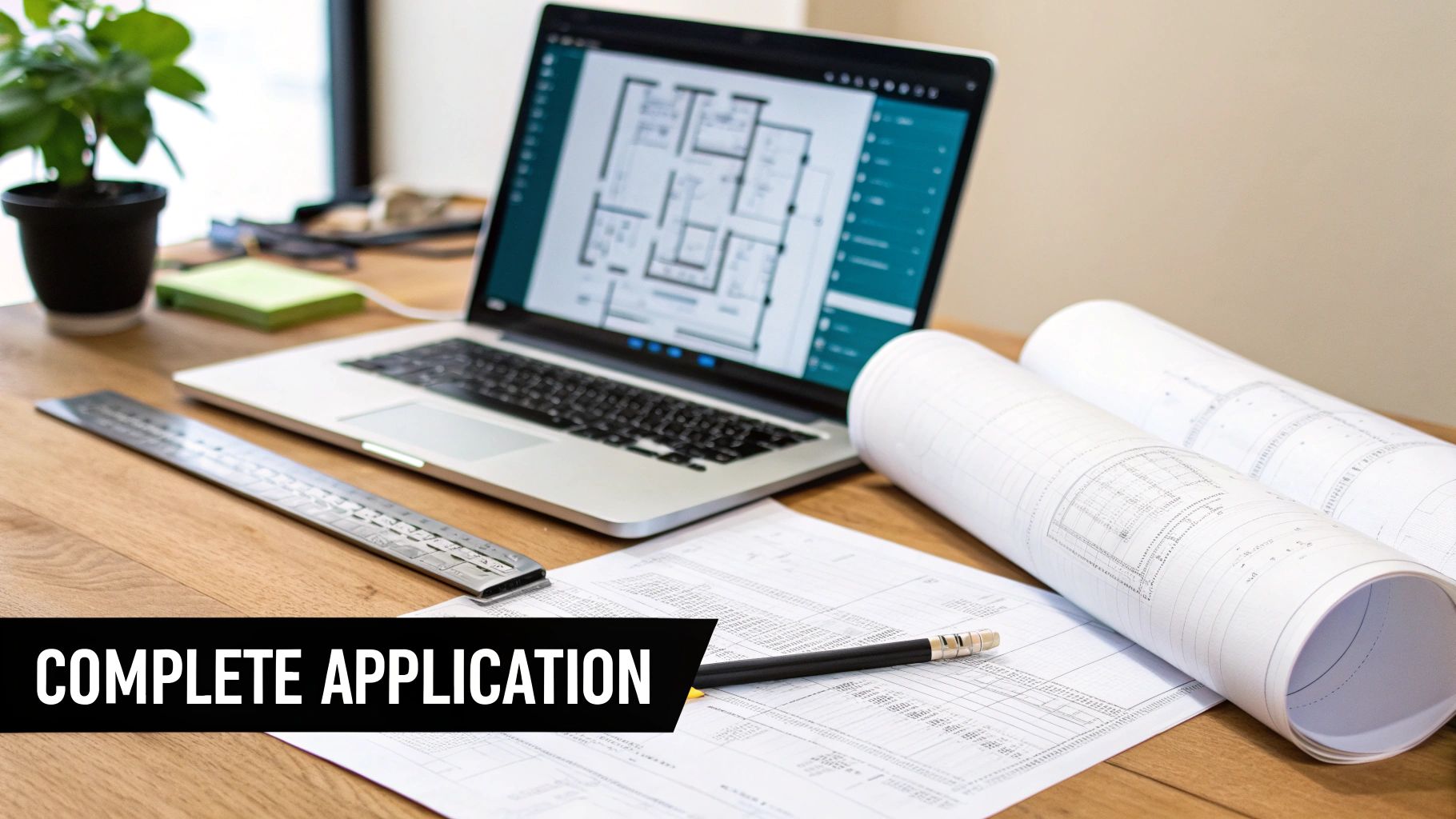
The Core of Your Application: Architectural Drawings
Your architectural drawings are the heart of your submission. These aren't just pretty pictures; they are the detailed instructions that prove your project is safe, compliant, and buildable. A plan reviewer needs to see more than just a basic floor plan to give you the green light.
A truly complete set of drawings, like the construction-ready blueprints we provide, includes several key components that reviewers scrutinize:
Elevations: These show the house from all four sides—front, back, left, and right—detailing exterior materials, roof pitches, and window placements.
Foundation Plan: This document outlines the home's structural base, specifying footing sizes, slab thickness, and reinforcement, often based on the soil conditions.
Framing Plans: Think of these as the skeleton. They show exactly how the floors, walls, and roof will be constructed, and they're critical for proving structural integrity.
Electrical and Plumbing Layouts: These schematics outline the placement of every outlet, switch, fixture, and pipe, ensuring that everything complies with safety codes.
Cross-Sections and Details: These are cut-through views that show how different parts of the house connect, clarifying complex construction elements from the foundation to the roof.
Starting with a professionally designed plan set for permitting is your greatest advantage. It immediately conveys to the reviewer that your project is serious and well thought out.
Key Takeaway: Vague or incomplete plans are the number one cause of rejection during the plan review. A complete set of drawings answers questions before they're even asked, dramatically speeding up the entire process.
Beyond the Blueprints: Essential Supporting Documents
While your plans are the main event, the application is a package deal. Several other documents are required to provide the building department with a comprehensive picture of your project and its impact. Overlooking any of these is a common—and costly—mistake.
A robust submission will almost always include a precise site plan. This is a top-down map of your property that shows exactly where the new structure will sit. It must clearly illustrate:
Property Lines: The legal boundaries of your lot.
Setbacks: The required distances from your structure to property lines and roads.
Easements: Any areas where utility companies or others have a right of access.
Existing Structures: The location of any other buildings or driveways on the lot.
You might also need structural engineering calculations. These are often required for projects with non-standard loads, unique soil conditions, or in areas with high winds or seismic activity. An engineer’s stamp on these calculations gives the jurisdiction third-party verification that your design is safe.
Other documents that are frequently required include:
Material Specifications: A list of the specific products you plan to use.
Energy Efficiency Reports: Calculations showing your home meets local energy codes (like a REScheck or Title 24 report).
Geotechnical Reports: A soil analysis that informs the foundation design.
Navigating local requirements can be tricky. Resources like this guide to Cape Coral Building Permits: Your Simple Guide can help clarify unique regional rules. Remember, the more organized and detailed your submission, the faster you’ll get that coveted approval. You can also contact us to request data on local requirements for any of our home plans.
Getting Your Application Submitted and Through Review
You’ve done the hard work, gathered every document, and now you have a complete application package ready to go. This is the moment your careful planning gets its first real test. It’s time to formally submit everything and step into the often-mysterious world of the plan review.
How you hand things over really depends on your local building department. Many cities now have sleek online portals where you can upload all your files and pay the fees immediately. But plenty of others are still old-school, requiring you to drop off several giant, rolled-up sets of paper blueprints at a physical counter. Make sure you know which one it is before you show up to avoid getting turned away at the door.
What Really Happens During Plan Review
Once you submit your application, it doesn’t just land in one person’s inbox. It is routed to a team of specialists in various departments. Think of them as a panel of experts, each examining your project through their own specific lens to make sure every single detail is up to code.
Your plans will almost certainly make their way across these desks:
Zoning Officer: This person lives and breathes land-use rules. They’ll review your site plan and verify it against local ordinances, including setbacks from property lines, maximum building height, and the percentage of your lot that the structure covers.
Structural Reviewer: Usually a licensed engineer, this reviewer is focused on the bones of your project. They will scrutinize your foundation plans, framing details, and load calculations to ensure the building is safe and sound against local forces, such as heavy snow, high winds, or even seismic activity.
Fire Marshal: Safety and emergency access are their entire world. They're looking for proper exit routes (e.g., egress), smoke detector placement, and whether a fire truck can actually access your driveway if needed.
Public Works/Utilities Department: This team is responsible for ensuring your project is connected to the grid. They’ll review your plans for water and sewer connections and check your strategy for managing stormwater to ensure it all integrates seamlessly with the municipal systems.
Each of these reviewers will make notes, often referred to as "redlines," directly on your plans to flag any areas that need to be corrected or clarified.
How to Handle Reviewer Comments
Getting a list of comments or required corrections after the first review is completely normal—in fact, you should probably expect it. Don't let it discourage you. The key is how quickly and clearly you address their points.
Let's imagine a common scenario. The zoning reviewer sends back a comment: "Proposed deck encroaches 2 feet into the 10-foot rear setback. Revise plan to show compliance or apply for a variance."
You’ve got two paths forward:
Revise the Plan: This is almost always the easiest and fastest option. You’d have your designer shrink the deck by two feet, update the drawings, and resubmit the corrected pages.
Seek a Variance: If losing those two feet is a dealbreaker for your design, you can apply for a zoning variance. This is essentially requesting a special exception to the rule, but be warned: it triggers a separate, often lengthy public hearing process with no guarantee of success.
For most minor comments, just fixing the plan is the best way to keep your project on track. When you’re prompt and thorough, it shows the reviewer you’re on top of things, and that can go a long way in speeding up the next round.
Pro Tip: When you resubmit your plans, always include a short response letter. List each comment from the city, and right next to it, explain exactly how and on which page you fixed it. This little bit of effort saves the reviewer from having to hunt for your changes and can shave days or even weeks off your timeline.
This back-and-forth might feel a bit tedious, but it’s precisely this level of detail that makes permitted structures so safe and valuable. The process is complex everywhere. A World Bank study found that building a simple warehouse involves an average of 15.1 different procedures and takes over 152 days to get approved across 190 different economies. You can see more details in these global construction permit indicators—it really highlights how well-prepared plans can cut through the red tape.
Finally, try to resist the urge to call the permit office every other day for an update. Most online portals have a status tracker you can check. If you really feel the need to follow up, a polite email once a week is more than enough. Ultimately, your best tool for speeding things up is providing a quick and complete response when they ask for one. That’s how you get closer to breaking ground.
Passing Your Inspections and Getting Final Approval
Obtaining your building permit is a significant milestone, but it's really just the starting point. Now the real work—and the real oversight—begins as your project jumps off the page and into the real world. This is where the inspection process comes in, ensuring that every single nail, pipe, and wire is installed exactly as it was drawn up in your approved plans.
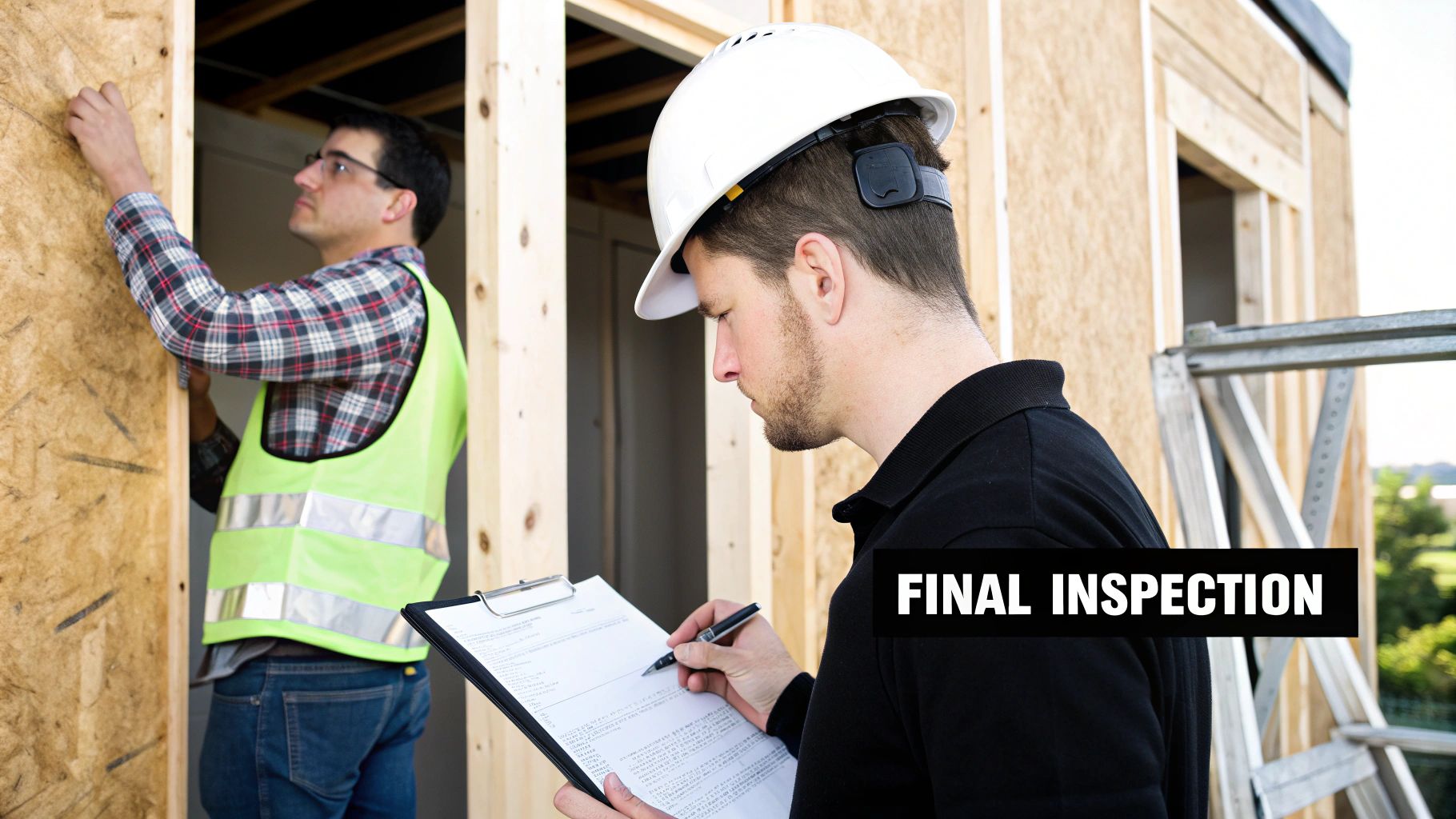
This series of on-site visits from a local building inspector is an absolute must. Think of them as critical checkpoints. The inspector's job is to verify that the work meets all current safety and building codes before it gets covered up by drywall or concrete.
Mapping the Typical Inspection Sequence
While every project has its own unique quirks, most construction projects follow a fairly logical inspection order. You can't call for a framing inspection before the foundation gets the thumbs-up, and you definitely can't start hanging drywall until the electrical and plumbing guts behind it get a green tag.
Here’s a common sequence you can expect to work through:
Foundation and Footing Inspection: This is almost always the first visit. The inspector is there to check that the trenches are dug correctly, the forms are solid, and all the rebar is in place before you pour a single yard of concrete.
Framing or "Rough-In" Inspection: Once the home's skeleton is up, this major inspection confirms that all the studs, joists, rafters, and fire-blocking are installed correctly. This is a big one.
Plumbing, Electrical, and Mechanical Rough-In: Before any insulation or drywall is installed, separate inspectors will come to verify all the hidden components—the pipes, wires, and ductwork snaking through the walls and ceilings.
Insulation Inspection: After the other rough-ins pass, an inspector will verify that the correct type and amount of insulation are installed properly to meet your local energy codes.
Final Inspection: This is it, the last hurdle. The inspector conducts a thorough walkthrough to ensure the entire project is complete, safe, and ready for occupancy. They’ll check everything from smoke detectors and stairway handrails to GFCI outlets.
Passing each stage gives your contractor the green light to proceed. A failed inspection, on the other hand, results in a stop-work order for that phase until the issue is resolved and the phase is reinspected.
How to Prepare for a Smooth Inspection
A failed inspection costs you time and money—period. The best way to dodge that bullet is to be obsessively prepared for every visit. It's not just about doing the work correctly; it’s about making the inspector’s job as easy as possible.
Before scheduling an inspection, your crew should conduct a detailed walkthrough to identify common mistakes that often trip people up.
Common Red Flags That Cause Failed Inspections:
Inspection Type | Common Reason for Failure | How to Avoid It |
|---|---|---|
Foundation | Incorrect rebar placement or size | Triple-check the engineering plans. Make sure all steel is tied and spaced exactly as specified. |
Framing | Missing hurricane ties or improper notching | Ensure all the structural hardware is installed and that no one has cut into beams or joists in a way that weakens them. |
Electrical | Improperly secured wiring or overloaded circuits | Walk the job and check that wires are stapled correctly and breaker assignments match the load calculations. |
Plumbing | Incorrect pipe slope for drainage | Use a level to verify every drain line has that critical quarter-inch-per-foot slope. Gravity is your friend. |
Insider Tip: Always have the approved set of plans and the permit card displayed prominently on-site for the inspector. Nothing sours an inspector’s mood faster than showing up and not having the documents they need. This simple bit of organization can set a positive tone for the entire visit.
If you receive a red tag, listen closely to the inspector’s feedback, obtain a clear list of what needs to be fixed, and address it promptly. Once the corrections are made, you can schedule a re-inspection.
The Final Prize: The Certificate of Occupancy
After passing your final inspection with flying colors, you’re ready for the last piece of paper: the Certificate of Occupancy (or "CO"). This is the official document from your building department declaring that your project is safe, up to code, and legally habitable.
You absolutely cannot move in without it.
Getting your CO is the ultimate sign-off. It’s the official confirmation that you've successfully navigated the entire building permit process from start to finish. More importantly, it’s what finally allows you to turn a construction site into a home.
Common Permit Pitfalls and How to Sidestep Them
Obtaining a building permit can feel like navigating a minefield. After guiding countless projects from dream to reality, I’ve seen that most delays and budget blow-ups aren't just bad luck—they’re usually caused by a few common, and totally avoidable, missteps.
Knowing where these traps are hidden is the first step to avoiding them altogether.
The Peril of Overlooking Regional Specifics
One of the biggest mistakes I see is a simple failure to do hyper-local research. All building codes are local, and what’s perfectly fine in one county might be an absolute deal-breaker just a few miles down the road. This lesson hits especially hard for people building in unique environments.
Imagine you're building a gorgeous house in a coastal area. You submit a flawless set of plans that meet every standard, structural, and safety code, but it gets rejected. Why? Because you overlooked the local flood zone requirements. Now, the entire foundation design is useless and has to be re-engineered for elevated construction. That’s an instant delay of months and a budget increase of tens of thousands of dollars.
This kind of thing happens frequently. It could be specific wildfire-resistant materials required in California, wind-load calculations in Florida, or soil-specific foundation needs in Texas. Ignoring local rules is a guaranteed way to derail your project. Before you even think about submitting, you need to understand the exact rules for your specific piece of land. A great way to get ahead is by starting with designs engineered for these areas, like specialized coastal home plans, which already factor in many of these critical considerations.
Key Insight: Never assume a great set of plans is universally compliant. The building permit process is intensely local. Your first move should always be to confirm regional requirements like flood zones, wind loads, or seismic codes with your building department.
Underestimating Timelines and External Factors
Another classic mistake is being overly optimistic with your timeline. The permit office doesn't run on your schedule. Backlogs are common, and depending on your jurisdiction's workload, review times can stretch from a few weeks to several months.
That workload is also tied to the bigger economic picture. Recent statistics reveal the sensitivity of the building permit pipeline to economic cycles. For instance, the U.S. Census Bureau reported that 1.312 million housing units were authorized by building permits in August 2025 (seasonally adjusted annual rate), representing an 11.1% decline from the previous year. When permit volumes swing like this, it has a direct effect on review times. You can learn more about these housing market indicators and their trends to gain insight into the current climate. A perfectly prepared submission is your best shot at cutting through the noise and getting approved quickly.
Finally, the single most damaging mistake you can make is starting work before the permit is physically in your hand. I know it’s tempting to get a head start on demo or foundation prep. However, if an inspector drives by and sees unpermitted activity, they will immediately issue a stop-work order on your site.
This not only freezes all progress but often comes with hefty fines. Worse, it can sour your relationship with the building department for the rest of the project. The rule is simple and absolute: no permit, no work.
Frequently Asked Questions About the Building Permit Process
Even with a perfect roadmap, you're likely to have questions arise during the permit process. These are the practical, in-the-weeds issues that can derail a project if you don't have good answers. We've compiled some of the most common questions we hear from homeowners and builders to give you a head start.
Do I Really Need a Permit for Minor Home Renovations?
Honestly, probably more often than you'd think. You can usually skip the paperwork for simple cosmetic projects, such as painting or laying down new carpet. But the moment you touch your home's structure, electrical, or plumbing systems, a permit is almost always required.
Consider projects such as removing an interior wall, installing a new window, replacing your entire roof, or even building a deck.
The best rule of thumb is: if it impacts safety or primary systems, you probably need a permit. Every town has slightly different rules, so a quick call to your local building department is the best way to ensure accuracy. Getting caught without one is a nightmare—it can mean steep fines and, in the worst-case scenario, being forced to tear out your brand-new work.
How Long Does the Building Permit Process Usually Take?
This is the classic "it depends" answer, and the timeframes can vary wildly. For a straightforward project like a standard deck, you can typically obtain your permit within a few weeks. But for a brand-new custom home, it could easily stretch into several months.
The biggest things that affect your timeline are:
Project Complexity: A major addition with complex engineering will always take longer than a simple interior remodel.
Jurisdiction Workload: Is your local permit office slammed? If they are, everything will naturally move more slowly.
Application Quality: This is the one area where you have total control. An incomplete application is the fastest way to add weeks of delays while you go back and forth with the plan reviewer.
This is where starting with professional, code-compliant plans makes all the difference. A clean, complete application package tends to move through the system much faster.
What Is the Difference Between a Building Permit and a Zoning Permit?
This is a common point of confusion, but they serve two very different purposes.
Think of it like this:
A zoning permit is all about what and where you can build. It’s the town’s way of confirming your project follows local land-use rules—things like how far you are from the property line (setbacks), building height limits, and what the property can be used for (residential vs. commercial).
A building permit is about how you build it. This permit focuses on ensuring the construction meets all technical building codes for structural integrity, fire safety, electrical systems, and other relevant standards.
You almost always need to obtain your zoning approval before applying for the building permit. They are two separate hurdles you have to clear in order.
Can I Apply for a Permit Myself or Should I Hire a Pro?
Most places allow homeowners to pull their own permit for work on their primary residence, often referred to as a "homeowner-builder" permit. The big catch here is that when you sign the application, you assume all the legal responsibility for ensuring the work meets every single code and passes every inspection.
If you’ve hired a licensed general contractor, they will almost always handle the entire permit process as part of their fee. For any complex project—such as a major addition or a new home—enlisting an experienced professional to manage it is absolutely the way to go. They know the local staff, understand the unwritten rules, and can often clear up minor issues with a quick phone call that might take you weeks to resolve.
For more answers to common questions, you can also explore our detailed home plan FAQs that cover everything from plan modifications to construction details.
At RBA Home Plans, we provide construction-ready blueprints designed to meet code and streamline your building permit process. Discover your ideal plan and begin your journey today at https://rbahomeplans.com.


Comments