
Two Bedroom Small Home Plans under 1000 sq ft: How to make them livable | RBA Home Plans
Two-bedroom house plans around 1000 sq ft are hitting a real sweet spot in home design. They manage to feel both efficient and genuinely comfortable, offering plenty of space for small families, couples, or singles without the headaches of a massive house. These smart designs are all about making every inch count, often using open-concept layouts and split-bedroom plans to create a home that works.
It's no surprise they're becoming such a popular choice.
Why 1000 Sq Ft Is The New Sweet Spot For Homes
Choosing a 1000 sq ft home is about more than just size; it’s a conscious move toward a more manageable and intentional way of living. This footprint strikes a fantastic balance—you get enough room to breathe without the extra costs and constant upkeep that come with a larger property. It’s the Goldilocks of housing: not too big, not too small, but just right for a growing number of people.
In a world where "more" can feel overwhelming, a well-designed compact home is a breath of fresh air. It’s a shift toward quality over quantity, focusing on spaces you'll actually use instead of rooms that just collect dust. This change in thinking is exactly why two-bedroom house plans around 1,000 sq ft are gaining popularity with a wide range of people.
The Financial And Lifestyle Advantages
Opting for a smaller home brings numerous real-world benefits that you'll feel in your wallet and in your daily routine. The most obvious win is financial. A 1000 sq ft house isn't just more affordable to build; it keeps saving you money year after year.
Here's a look at what that means for you:
Lower Utility Costs: With less space to heat and cool, your monthly energy bills will be noticeably lower. That's a consistent saving you'll appreciate every month.
Reduced Maintenance: A smaller home means less to clean, fix, and worry about. You'll get to spend less time on chores and more time actually enjoying your home.
Smaller Environmental Footprint: Building and operating a 1000 sq ft home requires fewer resources, making it a more sustainable and eco-friendly choice.
Greater Affordability: The lower price point makes homeownership a reality for many first-time buyers. For others, it frees up cash for travel, investments, or other passions.
Who Benefits Most From This Smart Size
While this size may not be for everyone, it's the perfect fit for a few key groups. For first-time homebuyers, it's a smart way to enter the market without being burdened with a huge mortgage. It serves as a stepping stone to building equity and financial security.
Empty-nesters often find downsizing to a 1000 sq ft home incredibly liberating. They can escape the demands of a large family house and settle into a comfortable, easy-to-manage space for their next chapter—all without giving up that crucial second bedroom for guests or a hobby room.
This size is also a great match for small families and couples who prioritize their lifestyle and location over raw square footage. A well-designed, compact home in a great neighborhood often beats a sprawling house way out in the suburbs.
To put it in perspective, a 1000 sq ft footprint is less than half the size of the typical new American home, which currently averages around 2,333 square feet. Yet, these plans cleverly incorporate two bedrooms, one or two bathrooms, and comfortable living areas. This demonstrates that you don't need thousands of square feet to live a full and happy life at home.
Exploring The Most Popular Layout Strategies
Making 1000 sq ft feel spacious and livable isn’t about some architectural magic trick—it’s all about smart layout design. The way rooms flow from one to the next really dictates how a home lives and breathes. Before we delve into specific strategies, it's helpful to have a solid understanding of the basics, such as grasping floor plans and how architects transform ideas into actual blueprints.
With that foundation, let's explore the three most common configurations that really make the most of every inch in a two-bedroom house plan 1000 sq ft. Each one offers a totally different way of living, so picking the right one comes down to what you need—from how you entertain to how much privacy you crave.
The Open Concept Social Hub
The open-concept layout is, without a doubt, the reigning champ for smaller homes today. Picture a modern loft apartment—it eliminates interior walls between the kitchen, living room, and dining area to create one large, connected social space. This design approach is ideal for making a small space feel larger and more inviting.
By knocking down those visual barriers, natural light floods the entire living area, creating a bright, airy vibe. This setup is ideal for individuals who enjoy hosting gatherings. You can be in the kitchen prepping food and still be part of the conversation with your guests. It really fosters a sense of togetherness and turns the home into a central hub for friends and family.
The biggest win with an open layout is the illusion of space it creates. Removing walls instantly makes the area feel larger, brighter, and more welcoming, which is a massive advantage when you're working with a 1000 sq ft footprint.
The Split Bedroom Private Retreat
For anyone who puts a premium on privacy, the split-bedroom layout is a brilliant solution. This strategy places the primary suite on one side of the house and the second bedroom on the complete opposite side. The common living areas, like the kitchen and living room, act as a buffer right in the middle. It’s like having two separate, quiet wings in one home.
This configuration is a great fit for all kinds of living situations:
Roommates: It provides each person with their own private space, reducing noise and disturbances.
Families with Teenagers: Parents get their own retreat while giving their older kid a sense of independence.
Hosting Guests: Visitors have their own secluded area, making their stay more comfortable for everyone involved.
The separation is great for minimizing sound transfer between the bedrooms, a huge plus if people have different schedules. If you want to dig deeper, check out our ultimate guide to split-bedroom floor plans. This design smartly solves one of the biggest challenges of compact living: keeping your personal space.
The Traditional Zoned Layout
While open-concept plans get all the attention, there’s still a strong case to be made for a more traditional, zoned layout. This approach uses walls to create distinct, separate rooms for different activities—a formal living room, a closed-off kitchen, and a defined dining area. It's a classic design that brings a sense of structure and purpose to each space.
The main advantage here is containment. Cooking smells from the kitchen stay put, and the sound from the TV won’t bother someone trying to have a quiet dinner. This layout also gives you more wall space for hanging art, placing furniture, and adding storage. For those who prefer a cozier, more compartmentalized home, a traditional floor plan can be the perfect fit for a two-bedroom house plan, 1000 sq ft.
Comparing 1000 Sq Ft Two-Bedroom Layouts
Each layout style offers a different living experience, and what works for one person might not work for another. This table breaks down the core benefits and potential downsides of these common configurations to help you see which one might be the best match for your lifestyle.
Layout Style | Core Concept | Ideal For | Consideration |
|---|---|---|---|
Open Concept | Combines kitchen, living, and dining into one large, shared space. | People who love to entertain, families with young children, and those who want a spacious feel. | Noise travels easily, and cooking smells can spread throughout the main living area. |
Split Bedroom | Places bedrooms on opposite sides of the home, separated by common areas. | Roommates, families with older kids, or anyone hosting frequent overnight guests. | It can sometimes feel less connected than other layouts; it requires a central living zone. |
Traditional (Zoned) | Uses walls to create distinct, separate rooms for each function. | Homeowners who value privacy, need defined spaces, and want to contain noise and mess. | It can make a small footprint feel even smaller and may limit natural light flow. |
Ultimately, choosing between open, split, or traditional isn't about right or wrong—it's about finding the floor plan that feels like home to you. Consider your daily routines, how you utilize your space, and what makes you feel most at home.
How To Maximize Every Square Foot
When you're working with a compact home, every single design choice counts. Making the most of a 1000 sq ft footprint isn’t about sacrificing what you want; it’s about making smart, deliberate choices that actually improve how you live. This is your chance to figure out what truly matters to you and turn potential limitations into brilliant design features.
Every floor plan is a series of trade-offs. The trick is to weigh these choices against your real-life habits, not just some generic checklist of features. That way, you end up with a home that truly works for you, supporting your daily routines every day.

Making Smart Space Trade-Offs
As you look through two-bedroom house plans less than 1000 sq ft, you’ll run into some classic dilemmas. Do you go for a second full bathroom or a huge walk-in closet? Is a dedicated office nook more critical than a larger, open living room? There are no right or wrong answers here—only what's right for you.
Think about these common scenarios:
Extra Bath vs. Extra Storage: For families or roommates, a second bathroom can be a lifesaver. However, if you live alone or as a couple, you may derive more value from a spacious walk-in closet or a larger pantry.
Home Office vs. Living Space: If you regularly work from home, a small, dedicated workspace is practically a necessity. If you're rarely at a desk, you might prefer to give that square footage to a larger living area for entertaining and relaxing.
Formal Dining vs. Kitchen Island: A separate dining room has a traditional charm, but a large kitchen island with bar seating is often more versatile for casual meals, homework sessions, and entertaining friends while you cook.
The best way to decide is to walk through your day in the space mentally. For more layout ideas, check out our guide on the top small home layout ideas to maximize space.
Creating The Illusion Of Space
Beyond the layout, a few architectural tricks can make a 1000 sq ft home feel much bigger than it is. These design elements play with light and perspective, creating an open, airy feeling that defies the actual measurements.
A key strategy is to draw the eye upward. Vaulted or high ceilings can dramatically open up a room, making it feel grand and less confined. Even a modest 9-foot ceiling feels more spacious than the standard 8-foot height.
Strategic window placement is another powerful tool. Large windows don't just fill a room with natural light; they connect the inside with the outdoors, making your living area feel like it extends into the yard. Clerestory windows—those small windows placed high up on a wall—are another great trick for letting in light while keeping your privacy. To see how impactful these choices can be, explore these brilliant tiny house interior design ideas.
Non-Negotiable Elements For Compact Living
While some features are debatable, others are just plain essential for making a smaller home feel both functional and comfortable. As you review floor plans, keep an eye out for these non-negotiables. Smart storage and multi-functional design should be at the very top of your list.
Think beyond just having a few closets. A great small-home plan weaves clever storage opportunities throughout.
Built-In Storage: Look for plans with built-in bookshelves, window seats with hidden compartments, or mudroom benches. These features add a great deal of character and utility without occupying floor space.
Multi-Functional Furniture: Your furniture will have to work hard, too. Think of an ottoman that doubles as a coffee table with storage inside, or a Murphy bed that can turn an office into a guest room instantly.
Vertical Space: Don't forget to look up! Tall bookshelves, kitchen cabinets that stretch to the ceiling, and simple wall-mounted shelves all help free up the floor and make rooms feel taller.
By prioritizing these elements, you’ll ensure your 1000 sq ft home is not just stylish but incredibly practical, letting you live comfortably and without the clutter.
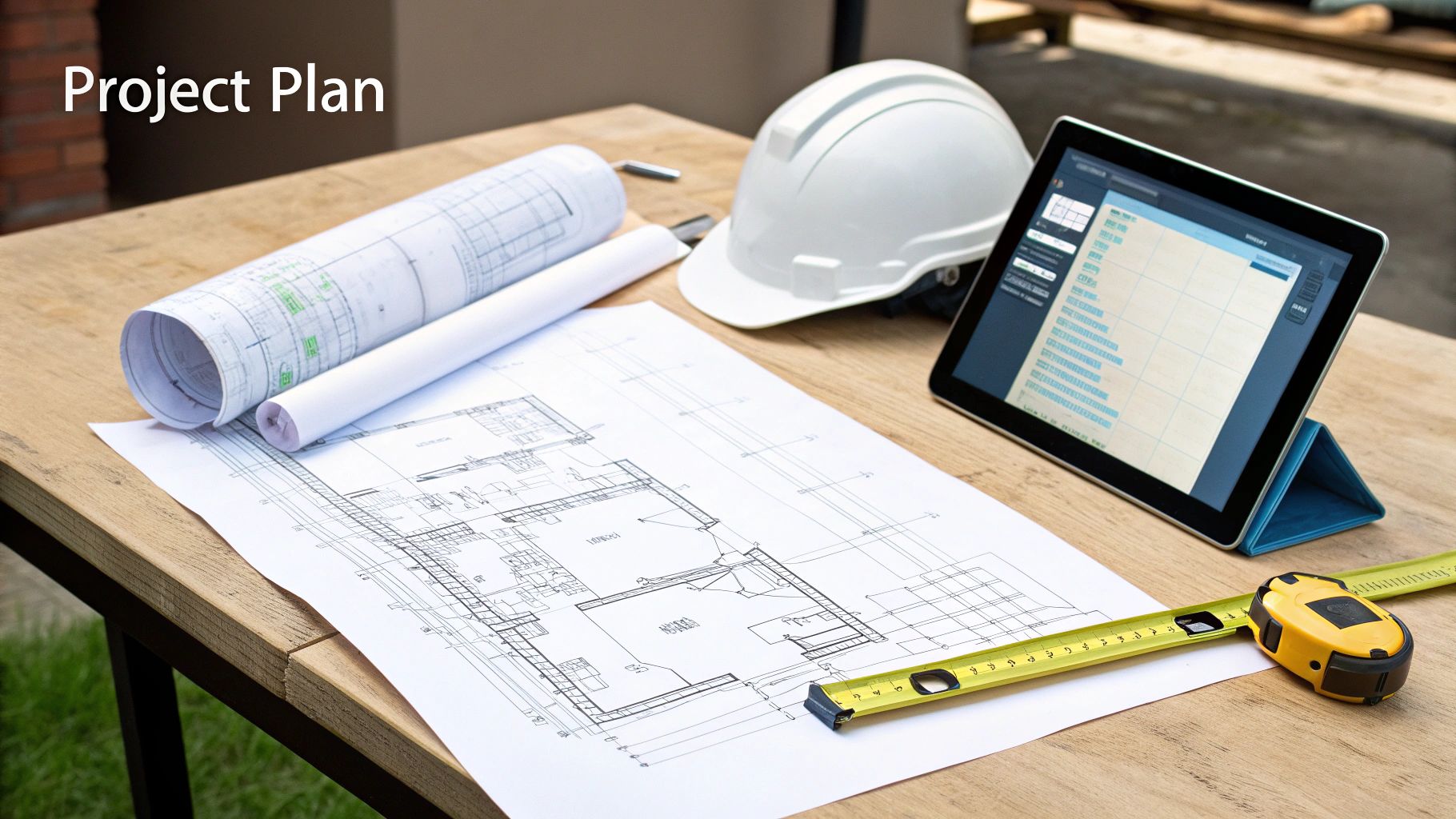
From Blueprint To Building: A Realistic Project Plan
So, you’ve found the perfect two-bedroom, 1000 sq ft house plan. That’s a huge, exciting step! But turning those drawings into a real, livable home is a journey, and it can feel a little overwhelming at first. The secret to a smooth project? A realistic plan, right from the get-go. This means looking way beyond the price of the blueprints and getting a handle on all the moving parts that come together to build your house.
Think of your house plan as the recipe for your favorite meal. The recipe is critical, of course, but it doesn’t tell you the cost of the ingredients, what pots and pans you’ll need, or how much time to set aside for prep and cooking. Building a home is the same. You must budget for the land, labor, materials, and the maze of permits and codes. A clear roadmap makes the whole process less stressful and helps you avoid those costly surprises that can arise along the way.
Unpacking The True Costs Of Construction
The price tag on your house plan is just the starting line. The real number to focus on is the "turnkey" cost—what it takes to get your home completely finished and ready for you to move in. Nailing down a detailed budget that accounts for everything is probably the single most important part of your project plan.
Here are the major cost buckets you'll need to fill:
Land Acquisition and Prep: This isn't just the purchase price of the lot. You also have to factor in the cost to clear it, grade the soil for proper drainage, and get it ready for construction. These first steps are the foundation (literally!) of a good build.
Foundation Work: Depending on your plan and local conditions, you might be looking at a slab, a crawl space, or a full basement. The costs here can swing wildly based on your soil type and the foundation you choose.
Building Materials: This is a big one. It covers everything from the lumber framing and roofing all the way down to the windows, doors, and insulation. Material prices can fluctuate, so it’s always smart to build a little cushion into your budget.
Labor and Contractor Fees: Unless you’re a pro builder yourself, you’ll be hiring a team. This means your general contractor, electricians, plumbers, roofers, and all the other skilled tradespeople who bring the plan to life.
Permits and Fees: Every town and county has its own list of required permits and inspection fees. Don't underestimate this—it can easily add several thousand dollars to your total cost, and it's absolutely non-negotiable.
Navigating Building Codes And Local Permits
Every single construction project has to follow a strict set of rules called building codes. These aren’t suggestions; they’re legal requirements designed to make sure your home is safe, healthy, and structurally sound. They cover everything from the gauge of your electrical wiring and the layout of your plumbing to the minimum height of your ceilings.
Your local building department is the final word on these codes. Before you can even think about digging, your plans have to be submitted and approved. Trying to skip this step is a recipe for disaster—you could face huge fines, stop-work orders, or even be forced to tear down what you’ve already built.
This is where having a professional in your corner is a game-changer. The permit process can be a headache, but it’s a crucial checkpoint to ensure your home is built right from day one.
The Role Of A General Contractor
For most of us, a general contractor (GC) is the most important person on the team. A good GC is the project manager for your entire build. They coordinate all the different trades, keep things on schedule, and make sure you stay on budget. Think of them as the conductor of an orchestra, ensuring every instrument comes in at just the right time.
A general contractor’s job usually includes:
Hiring and Managing Subcontractors: The GC is responsible for finding and vetting all the pros, from the foundation crew to the painters.
Scheduling Inspections: They know exactly when to call the local inspectors for sign-offs at critical stages of the build.
Ordering Materials: They handle the logistics of getting lumber, windows, and everything else to the site right when it’s needed.
Overseeing Quality Control: Your GC is your set of eyes and ears on the job site, making sure the work meets the high standards laid out in your plans.
Trying to manage a build yourself is more than a full-time job. A reliable contractor takes that weight off your shoulders so you can focus on the big picture. To get a better feel for how all these pieces fit together, check out our guide to the typical house construction timeline from start to finish. By understanding the real-world steps and costs, you can turn your 1000 sq ft house plan into a home with confidence.
Personalizing Your Stock House Plan
Think of a stock house plan as a fantastic starting point, not a rigid set of rules. A lot of people don't realize just how flexible these pre-designed plans can be. You can take a design that's almost perfect and make a few strategic tweaks to create a home that feels completely custom, all without the cost and hassle of starting from scratch with an architect.
This is your chance to make a great design fit your specific needs, your lot, and your way of life. It’s about turning a blueprint into your home.
High-Impact Modifications That Make a Difference
You don't need to reinvent the wheel to make a big change. Even small, thoughtful adjustments to a two bedroom house plan 1000 sq ft can totally transform the way it feels and functions. The goal is to improve the home's livability and make it line up with your personal vision.
Here are a few common, high-impact modifications to consider:
Shifting Interior Walls: Moving a non-load-bearing wall to make a bedroom a little bigger or carve out a spacious walk-in closet is often a simple change that adds a ton of value.
Adding Outdoor Living: Tacking on a back deck or a screened-in porch can dramatically expand your usable living space, blurring the lines between indoors and out.
Changing Window and Door Placement: Want to capture the morning sun in your kitchen? Or frame that perfect backyard view from the living room? Adjusting window sizes and locations is a powerful way to do it.
These kinds of changes let you fine-tune the flow and feel of your home, making sure it supports your daily routines perfectly.
The real beauty of modifying a stock plan is getting a custom-fit home at a fraction of the cost. You're using a professionally designed foundation and layering your personal preferences on top to create something truly unique.
Even with a compact footprint, the market for 1000 sq ft house plans is incredibly diverse. Major architectural retailers showcase hundreds of designs packed with desirable features like cathedral ceilings, master suites, and basement options, proving that smaller homes can be highly sophisticated. You can even find plans with anything from zero- to four-car garages, which just shows how versatile these designs really are. You can find out more about the variety in 1000 sq ft home designs.
The Modification Process Step By Step
So, how do you actually make these changes happen? It’s a collaborative process between you and an architectural firm like RBA Home Plans. We have a structured path to make sure your modifications are safe, code-compliant, and accurately shown in the final construction documents.
Here’s a typical breakdown of the steps involved:
Initial Consultation: It all starts with a conversation. You'll discuss your desired changes with our design team, bringing your ideas, sketches, and wish list to the table.
Preliminary Review: Our designers will take a look at your requested modifications to see if they're feasible, considering any structural implications or effects on the rest of the layout.
Quote and Agreement: Once we're clear on the scope of work, you'll get a quote for the modification services. This usually covers the design time and the cost of redrawing the affected plan sheets.
Drafting and Revisions: The architectural team will then create a preliminary draft of the modified plans for your review. This is your chance to give feedback before the final drawings are done.
Final Construction Documents: After you give your approval, we'll produce a full set of updated, build-ready blueprints that your contractor can use to bring your personalized home to life.
Understanding Costs And Timelines
Modifying a stock plan is definitely more affordable than a fully custom design, but it’s important to budget for the extra costs. The price of modifications really depends on how complex they are. A simple change like moving an interior door will cost much less than reconfiguring a roofline or adding a garage.
The timeline also varies. Minor tweaks might only take a few days, while bigger changes could take several weeks. The key is to communicate clearly with your design firm to get a realistic estimate for both cost and timing upfront. This investment ensures your builder has accurate, professional plans to work from, which prevents costly mistakes and delays during construction.
You've done the homework—weighed the layouts, thought through the practicalities, and now you're ready for the fun part. It's time to find that perfect two bedroom, 1000 sq ft house plan that feels like it was designed just for you. Our job is to make that hunt as simple and inspiring as possible.
Think of our website's search filters as your personal guide. Instead of getting lost in hundreds of plans, you can quickly narrow the field to only the ones that match exactly what you're looking for. This is where you go from planning your future home to actually finding it.
Using Our Filters To Pinpoint Your Plan
Head over to our main search page, and you'll find a set of straightforward filters. This is where you can plug in all the details you’ve been dreaming about and see what our catalog has to offer.
The screenshot below shows our advanced search panel. Here, you can specify everything from square footage and bedroom count to garage bays and foundation types.
This tool lets you instantly zero in on a two bedroom house plan around 1000 sq ft and layer in your preferred architectural style, making sure the results tick all your boxes.
Here’s a quick guide to using the filters effectively:
Square Footage: Start by setting a range. For a 1000 sq ft home, a good starting point is 900 to 1100 sq ft. This gives you a little wiggle room to see options just above or below your target.
Bedrooms and Bathrooms: Lock in two bedrooms. Then decide on your bathroom needs—a single shared bath, a "Jack and Jill," or maybe two full baths.
Architectural Style: What's your vibe? Are you drawn to the clean lines of a Modern Farmhouse or the classic charm of a Craftsman? Select your favorite styles to see plans that match your vision.
Additional Features: Don't forget the details that make a house a home! You can filter for must-haves like a front porch, a dedicated home office, or a specific foundation like a crawl space or slab.
So, What's Included in Your Plan Set?
Once you’ve found a plan you love, you'll want to know what you’re actually buying. Our plan sets are much more than just a simple floor plan. They are the complete construction documents your builder needs to bring your home to life, accurately and up to code.
Each RBA Home Plans purchase gives you a complete set of build-ready blueprints. This isn't just a sketch—it's the detailed, professional guide your contractor will follow from the first pour of the foundation to the final nail.
Your purchased plan set will typically include:
Detailed Floor Plans: These show the layout of each floor, with room dimensions, wall locations, and window and door placements all clearly marked.
Exterior Elevations: This is how your home will look from all four sides, detailing the materials, roof pitches, and the final curb appeal.
Foundation Plan: A precise drawing that outlines the foundation, including support beams, posts, and footing details.
Building Sections and Details: These are cross-section views that show how the different parts of the house fit together, ensuring everything is structurally sound.
Your Next Steps to Purchase and Build
Found "the one"? The last few steps are simple. Just add the plan to your cart and follow the prompts through our secure checkout. Once your purchase is complete, you’ll get your digital plan set, ready to share with your builder and the local permitting office.
From there, you get to start the really exciting part—getting bids from contractors and breaking ground. We’re here to support you as you move from blueprint to reality and turn that dream of a perfectly designed 1000 sq ft home into your new address.
Have a Few Questions?
Thinking about a 2-bedroom house plan around 1000 sq ft? It's a great choice, but it’s only natural to have a few questions on the practical side of things. Let's walk through some of the most common things people ask, from building costs to what it's actually like to live in one.
What's the Real Cost to Build a 1000 Sq Ft House?
This is always the big question, and the honest answer is: it depends. The final price tag can swing quite a bit based on where you're building, the plan's complexity, and the finishes you pick. But as a ballpark, most builders will tell you to plan for somewhere between $100 and $250 per square foot.
That puts your total construction cost in the neighborhood of $100,000 to $250,000. Just remember, that number usually covers the house itself—not the land, site prep, driveway, landscaping, or fees for permits and hooking up utilities. The only way to get a truly solid number is to chat with a few local builders. They know the costs for materials and labor in your specific area and can give you a detailed quote.
Is a 1000 Sq Ft, Two-Bedroom House Big Enough for a Small Family?
Absolutely. A smartly designed 1000 sq ft home can be a fantastic fit for a small family, like a couple with a young child. The secret isn't about having more space—it's about having the right space.
Here’s why it works so well for many families:
Just the Right Mix of Private and Together: A layout that puts bedrooms on opposite sides of the house gives everyone a quiet corner, while an open-concept living area in the middle becomes the heart of the home for family dinners and movie nights.
A Smart Financial Move: This size home lets a young family get into the market and build equity without being saddled with a massive mortgage. It frees up money for savings, travel, and everything else life throws at you.
A well-designed compact home almost forces you to live more intentionally. You focus more on quality time and experiences rather than just collecting stuff, which often brings a family closer together.
Do 1000 Sq Ft Homes Hold Their Value?
They really do. Homes in this size range tend to have excellent resale value because they hit a sweet spot in the market. They're affordable enough for first-time buyers trying to get a foot in the door and perfectly sized for empty-nesters ready to downsize and simplify. It's a constant, built-in demand.
If you want to make sure your home is a solid long-term investment, stick with a timeless architectural style like a Modern Farmhouse or a classic Craftsman. More importantly, prioritize a functional floor plan and don't cut corners on construction quality. A well-built, well-maintained home of this size in a good neighborhood is an asset that holds its value and usually appreciates nicely over the years.
Ready to find the blueprint for your future? Explore the full collection of thoughtfully designed house plans at RBA Home Plans and discover the perfect starting point for your dream home today. https://rbahomeplans.com


Comments