
Value Engineering in Construction A Home Builder's Guide
Updated: Jan 6
Let's get one thing straight: value engineering in construction isn't just about shaving costs off the budget. It’s a smart, systematic way to look at a project and find the absolute best value for the lowest possible long-term cost. Think of it less as corner-cutting and more as a strategic game plan to optimize performance, quality, and your final return on investment.
Unlocking Smarter Building Choices
Imagine a master chef reworking a classic recipe. They don't just pull out the most expensive ingredients to make the dish cheaper. Instead, they might swap one spice for a less costly one that actually brings a richer flavor, or they might tweak a cooking technique to improve the final texture while cutting down on prep time.
The final dish is not only more efficient to create but tastes even better. That’s exactly what value engineering is in the building world—it’s all about making smarter choices, not just cheaper ones.
This disciplined approach forces the entire team to ask one powerful question: "What is this part of the building supposed to do, and is there a better way to get that job done?" When you focus on the function instead of just the blueprint specs, you open the door to creative solutions that were probably overlooked. This mindset is what prevents you from overspending while often boosting the home's long-term performance and durability.
Distinguishing Value Engineering from Cost Cutting
It’s easy to confuse genuine value engineering with plain old cost-slashing, but they are worlds apart. One is a forward-thinking strategy that pays dividends for years, while the other is a reactive move that often creates headaches down the road.
Here’s a quick look at how these two approaches stack up.
Value Engineering vs Traditional Cost Cutting
Aspect | Value Engineering (VE) | Traditional Cost Cutting |
|---|---|---|
Primary Question | "How can we improve the value of this function?" | "How can we make this cheaper?" |
Focus | Function and performance over the building's entire life. | Immediate, upfront cost savings. |
Timing | Proactive, ideally started during the design phase. | Reactive, often done when budgets get tight. |
Outcome | Maintained or improved quality and performance at a lower life-cycle cost. | Often leads to lower quality, higher maintenance, and reduced lifespan. |
Approach | Collaborative and creative problem-solving. | A top-down directive to reduce spending. |
Simply put, cost cutting is about subtraction. Value engineering is about optimization. It’s a completely different philosophy that leads to a fundamentally better home.
Value engineering is a forward-thinking investment in a project's future. It prioritizes long-term performance and reduced operational expenses over minimal upfront savings, ensuring the final product delivers superior value for years to come.
This isn’t just a theory; it works on a massive scale. The famous Golden Gate Bridge was originally estimated to cost $100 million back in the 1930s. Through meticulous value engineering—optimizing steel types and rethinking construction methods—the final price tag came in around $35 million. That's a staggering 65% reduction without compromising an ounce of its iconic strength.
You can learn more about how far the industry has come by reading about the civil engineering market. For home builders and buyers today, applying these same principles means you can take a great house plan and turn it into a home that is both cost-effective and built to last a lifetime.
What's the Real Goal of Value Engineering?
When people hear "value engineering," they often think it's just a fancy term for cutting costs. But that’s not the whole story. It's less about asking, "How can we make this cheaper?" and more about asking, "How can we get the absolute best function and performance for the long haul?" It’s a strategic shift in thinking that leads to a fundamentally better home.
The main idea is to optimize life-cycle costs, not just the initial price tag to build the house. A builder might be tempted to save a few hundred bucks by installing lower-grade windows, but that’s shortsighted. A value engineering mindset looks at the bigger picture.
Think about it: choosing slightly more expensive, energy-efficient windows could save the homeowner thousands in heating and cooling bills over the life of the home. That's where the real value is hiding.
It’s the same logic with insulation. A builder might compare standard batt insulation to spray foam. Sure, spray foam costs more upfront, but its superior air-sealing can slash energy bills for decades. The true cost of the cheaper batt insulation is its initial price plus years of inflated utility payments.
Better Quality, Better Performance
Another huge goal is to improve the quality, durability, and overall performance of the building. Value engineering challenges the "this is how we've always done it" mentality, pushing us to find materials or methods that result in a stronger, longer-lasting, and lower-maintenance home.
This might look like:
Smarter Material Swaps: Choosing composite decking instead of traditional wood. It costs more initially, but it completely eliminates the yearly staining and sealing, and it won't rot. That saves the homeowner a ton of time and money down the road.
Upgrading Key Systems: Putting in a tankless water heater instead of a big, traditional tank. You get on-demand hot water, use way less energy, and the unit typically lasts longer. It’s a win for performance and long-term value.
Building Smarter and Greener
Sustainability is a big piece of the puzzle now, too. Value engineering helps find solutions that are better for the environment and often better for the wallet. This could mean using locally sourced materials to cut down on transportation emissions or designing the roof to be perfect for a future solar panel installation. These choices make a home more eco-friendly and resilient.
Finally, value engineering is about streamlining the construction process itself. By simplifying a complex design, standardizing things like window and door sizes, or using prefabricated elements, builders can cut down on labor time, minimize waste on the job site, and get the project done faster.
A more efficient construction process doesn't just lower direct costs like labor. It also reduces indirect costs like construction loan interest and site management, getting the keys into the buyer's hands sooner.
This whole process is getting a major boost from technology. The market for industrial engineering and construction software is expected to jump from $10 billion to $15 billion by 2030, and for good reason. Digital tools from companies like Autodesk and Procore let teams run simulations and test out cost-saving ideas virtually, before anyone swings a hammer. You can learn more about this trend in this market forecast on construction software.
When all these objectives work together, you don't just get a home that was cheaper to build—you get a home that's simply better.
A Step-by-Step Value Engineering Framework
Value engineering in construction isn’t some chaotic, slash-and-burn cost-cutting exercise. Far from it. It’s a disciplined, systematic process designed from the ground up to maximize genuine value. This structured approach, often called a job plan, ensures every single decision is deliberate and effective.
By breaking the project down into distinct phases, teams can really dig into a design’s core functions, spark some serious creativity, and make data-driven choices. The goal is always to enhance quality while getting the costs just right. Think of this framework as a roadmap, guiding the project team from hazy ideas to a solid, implemented solution. Each phase builds on the last, preventing guesswork and making sure every potential improvement is properly vetted.
It’s really about striking a balance between the core goals of value engineering: bringing down costs, boosting quality, and improving sustainability.
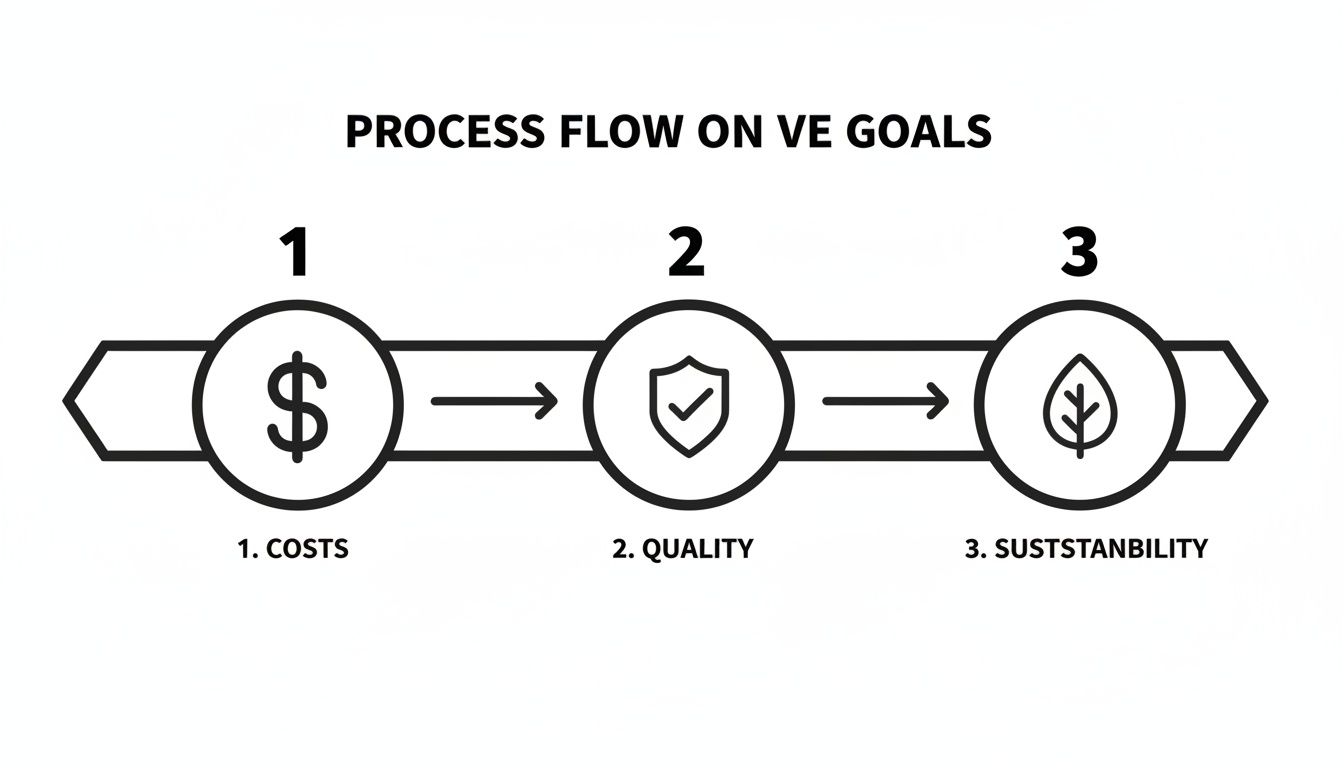
As you can see, these goals aren't competing; they're interconnected. They work together to deliver a much better final product. Let's walk through the standard phases of this powerful framework.
Phase 1: Information Gathering
This first step is all about doing a deep dive into the project details. The team gets its hands on every relevant piece of information—architectural plans, material specs, the budget, and of course, the client’s main objectives. The idea is to build a complete, shared understanding of the project’s scope, its limitations, and what success looks like.
Without this solid foundation, any analysis that follows would just be based on assumptions. This phase gets everyone on the same page before a single change is proposed. For homeowners and builders, this is the time to nail down expectations and define what "value" truly means for this specific project. To get this right from the start, it helps to check out a comprehensive guide to planning home renovation, which is great for understanding key budgeting and design strategies.
Phase 2: Function Analysis
Here, the focus shifts from what is being built to why. The team dissects every component of the project to figure out its primary and secondary functions. A simple example: a wall's primary function is structural support and shelter. A secondary function might be providing sound insulation.
By asking "What does this actually do?" and "What must it do?", the team can attach a cost to each function. This is a critical step because it shines a spotlight on areas where the cost is way out of proportion to the function it's performing—and those are your prime opportunities for value improvement.
Phase 3: Creative Brainstorming
With a clear picture of functions and their costs, the creative juices start flowing. This is a collaborative, no-holds-barred brainstorming session where the team throws out a wide range of alternative ideas for getting those essential functions done, often more efficiently or at a lower cost. At this stage, no idea is a bad idea.
The core principle of the creative phase is to challenge the status quo. By questioning every assumption and exploring unconventional solutions, teams can uncover innovations that deliver superior value without compromising the project's integrity.
For a custom home, this could look like:
Foundation Alternatives: If the lot is sloped, instead of defaulting to a standard poured concrete foundation, the team could explore a stepped foundation or a pier-and-beam system to cut down on excavation and material costs.
Siding Materials: On a modern farmhouse, maybe traditional wood siding isn't the best long-term value. The team might brainstorm using fiber cement siding, which offers a similar aesthetic but with far greater durability and a lower life-cycle cost.
Phase 4: Evaluation and Development
Now it's time to get critical. The ideas from the brainstorming session are put under the microscope. The team weighs each alternative against a set of criteria: Is it feasible? What are the real cost savings? How does it affect the schedule and long-term performance? Does it still align with the project’s main goals? The most promising ideas are then singled out for more development.
In this stage, those selected alternatives get fleshed out. The team might create sketches, calculate more precise costs, and map out exactly how the changes would be implemented. This process turns a raw idea into a viable, actionable solution backed by solid data.
Phase 5: Presentation and Implementation
Finally, the refined recommendations are formally presented to the project owner and other key stakeholders. This presentation clearly lays out the proposed changes, the logic behind them, the expected cost savings, and any potential impacts on quality or the timeline. Making a clear, compelling case is key to getting the buy-in needed to move forward.
Once everyone's on board, the value engineering changes are officially integrated into the project plans and construction process. The last step involves follow-up and monitoring to make sure the new solutions are implemented correctly and actually deliver the projected savings and performance benefits. This confirms the success of the entire value engineering effort.
Practical VE Techniques for Residential Construction
Bringing value engineering from a concept on paper to a real-world result on the job site is where the magic happens. In residential construction, this means making smart, specific choices that improve how a home works and lasts, all while keeping a close eye on the budget. It involves a detailed look at everything from the foundation to the final light fixtures, always hunting for opportunities to make smart substitutions and strategic simplifications.
Effective value engineering isn't just one big decision; it's a whole series of them. Every choice is a trade-off, where you weigh the upfront cost against future savings and overall quality. When builders and homebuyers get this right, the final home is not only more affordable but also better designed and more durable.
Material Substitutions That Add Value
One of the most powerful tools in the VE toolbox is swapping out materials. This isn't about picking cheap, low-grade options. Instead, it’s about choosing modern alternatives that perform better, install faster, or require less maintenance for a similar—or even lower—price.
Think about these common swaps:
Engineered Wood Products: Instead of using traditional solid lumber for floor joists and beams, engineered products like I-joists or laminated veneer lumber (LVL) offer superior strength and consistency. They don't warp like solid wood can, they can span longer distances, and they often reduce both the material and labor needed for framing.
PEX Plumbing Over Copper: Copper has been the standard for decades, but PEX (cross-linked polyethylene) tubing is a fantastic modern alternative. It’s flexible, requires fewer fittings (which means faster installation), and resists corrosion and freezing. The time saved on labor makes it a perfect example of value engineering in action.
Fiber Cement Siding: Classic wood siding looks great, but it needs constant painting and can fall victim to rot and pests. Fiber cement siding gives you a similar look but with far greater durability, fire resistance, and almost zero maintenance. The initial cost might be a little higher, but the long-term savings on upkeep are huge.
To give you a clearer picture, here are some common value engineering swaps you'll see on a residential job site. Each one represents a smart trade-off between cost, performance, and long-term value.
Common VE Swaps in Home Construction
Building Component | Standard Option | Value Engineering Alternative | Potential Impact |
|---|---|---|---|
Framing | Solid Sawn Lumber | Engineered I-Joists or Trusses | Straighter floors, faster installation, less material waste. |
Plumbing | Copper Pipes | PEX Tubing | Lower material and labor costs, resists freezing. |
Siding | Wood or Vinyl | Fiber Cement Siding | Higher upfront cost but huge savings on long-term maintenance. |
Insulation | Fiberglass Batts | Spray Foam or Blown-in Cellulose | Better R-value per inch, superior air sealing, potential energy savings. |
Windows | Custom-Sized Windows | Standard-Sized Windows | Significant cost savings, shorter lead times, easier replacement. |
Roofing | Complex Roofline (many gables) | Simplified Roofline (fewer planes) | Reduced framing/roofing labor, fewer potential leak points. |
As you can see, these aren't about cutting corners. They're about making informed decisions that deliver a better home for the money.
Design Simplification for Maximum Impact
Complex designs almost always come with a complex price tag. A big part of value engineering is simplifying a home's design to cut construction costs without losing its charm or function. The idea is to spot and eliminate unnecessary features that drive up expenses but don't add real value for the homeowner.
This is all about working smarter with the architectural plans—finding design elements that are disproportionately expensive and figuring out a more efficient way to get the same feel.
One of the key insights in home building is that the most elegant designs are often the simplest. By standardizing components and refining the building's shape, you can slash labor hours and material waste, which are two of the biggest cost drivers on any project.
Here’s how this plays out in the real world:
Standardize Window and Door Sizes: Custom windows and doors cost a fortune compared to standard, off-the-shelf sizes. By designing around common dimensions from the start, you avoid custom fabrication fees and long lead times.
Simplify the Roofline: A roof with a dozen gables, valleys, and sharp angles is a nightmare to frame and shingle. A simpler, cleaner roof design cuts labor costs, minimizes potential leak points, and uses materials much more efficiently.
Optimize the Foundation Footprint: A complicated foundation with lots of corners and jogs requires more concrete, more formwork, and more labor. By "stacking" walls on different floors and simplifying the home's overall shape, you can create a more straightforward—and less expensive—foundation.
Embracing Prefabrication and Modular Components
Another fantastic technique is to use prefabricated or modular components. These parts are built in a controlled factory setting, which leads to better quality, less on-site labor, and a much faster construction schedule. You minimize weather delays and streamline the assembly process, injecting a ton of value into the build.
On a typical home project, this could mean:
Using pre-built roof trusses and floor trusses.
Incorporating prefabricated wall panels.
Even using modular bathroom pods in larger multi-family projects.
Each of these strategies gets back to the core idea of value engineering: analyze what every part of the house is supposed to do, then find the smartest, most durable, and most cost-effective way to achieve it. Learning how to reduce construction costs with smart strategies is all about exploring these options to build a high-quality home without breaking the bank.
Integrating Value Engineering with Your Home Plans
This is where the rubber meets the road—turning the idea of value engineering into real-world decisions for your project. Think of your house plans not as a rigid set of rules, but as a fantastic starting point. A good VE review can transform those blueprints into a smart, efficient strategy that fits your budget, quality goals, and local building environment.
Many of our pre-designed plans already have smart, cost-effective features built right in. Architects often use standard room sizes and common materials to keep construction costs down without messing with the flow of the layout. But no stock plan can predict the unique quirks of your specific lot or what materials are readily available in your area. That’s why sitting down with your builder for a VE review is so critical.
Kicking Off the VE Review Process
The best time for this conversation is early on. I mean really early—before the plans are set in stone and long before anyone breaks ground. Making changes at this point is easy and cheap. If you wait until construction is already moving, you’re looking at expensive change orders and frustrating delays that can blow up your budget and timeline.
Your builder is your secret weapon here. They have the hands-on experience with local suppliers, labor, and building codes that an architect just can't match from an office. By going over the plans together, you can spot opportunities to make a good plan even better.
A proactive VE review isn't about criticizing the design. It's about adapting a great plan to the reality of your project, making sure every dollar you spend adds real, long-term value.
This team approach gets everyone on the same page, focused on one goal: building the absolute best home possible for the money you have. It’s all about asking "what if?" and "is there a smarter way to do this?" at every step.
Key Questions for Your Building Team
To make this conversation productive, you need to come prepared with the right questions. Your goal is to look past the obvious and explore alternatives that might perform better or cost less. A focused discussion can uncover some serious savings and big improvements.
Here’s a checklist of questions to bring to the table with your builder and designer:
Foundations and Site Work: "Looking at our soil report and the slope of the lot, is this foundation the most cost-effective? Could something like a stepped foundation or even insulated concrete forms (ICFs) give us better performance for the money?"
Structural Systems: "Can we adjust the framing layout to use less lumber and create less waste? Would engineered floor trusses work better here than standard joists to make running plumbing and electrical lines easier?"
Material Sourcing: "Are there local suppliers who offer better pricing or quality on materials? Can we save a significant amount on delivery by sourcing more materials from nearby?"
Building Envelope: "For our climate, does the specified insulation and window package give us the best bang for our buck on future energy bills? Can we improve the home's airtightness with a small upfront investment?"
Mechanical Systems: "Is this HVAC system the right size for our layout and climate? Would a different system, like mini-splits or geothermal, offer a better return on investment over the long haul?"
Even small tweaks to a pre-designed plan can make a huge difference. If you want to dive deeper into that process, we have a helpful guide that outlines the important things you should know if you want to modify your house plan.
By asking these kinds of questions, you stop being a passive observer and become an active participant in the value engineering in construction process. You’re making sure your new home is built not just to look good, but to perform brilliantly for your family and your wallet.
Measuring the True ROI of Value Engineering
It’s easy to look at value engineering and see only the immediate cost cuts on a budget spreadsheet. But the real payoff goes much, much deeper than that. The true return on investment (ROI) isn't just about saving a few bucks upfront; it unfolds over the entire life of the home, shaping its long-term financial health and how much the owner enjoys living there.
Think about it this way: a smart VE decision might mean upgrading from standard windows to high-performance, triple-pane units. Yes, that adds a little to the initial budget. But that single choice can generate an ROI of 8% to 10% every single year through lower heating and cooling bills. Over time, that upgrade more than pays for itself.
Beyond the Upfront Savings
The real financial muscle of value engineering is its power to slash future expenses. These long-term gains are where the initial thought and investment truly pay dividends, creating a home that’s simply less expensive to own and maintain for years, even decades, to come.
You’ll see this long-term ROI in a few key areas:
Reduced Energy Consumption: Making smart calls on insulation, windows, and HVAC systems directly translates to lower monthly utility bills.
Lower Maintenance Needs: Choosing durable, low-fuss materials like fiber cement siding or composite decking means less money spent on painting, staining, and repairs down the road.
Increased Property Longevity: A well-engineered home with a solid structure and smart moisture management systems is built to last longer with fewer major headaches.
This kind of forward-thinking turns a house from a simple building into a high-performing asset. To really get this right, a solid grasp of all project costs is a must. You can dive deeper into this with our guide to construction cost breakdown.
The Intangible Returns
Not every return shows up on a bank statement. Value engineering also delivers some huge benefits that you can't measure in dollars and cents, but they absolutely improve the quality of the home and the experience of building it. For example, simplifying a complicated roofline doesn't just cut material and labor costs—it also makes the construction schedule smoother and dramatically reduces the risk of future leaks.
The ultimate ROI of value engineering is a superior final product—a home that functions better, costs less to own, and provides greater satisfaction. It’s not an expense; it’s one of the smartest investments you can make in your project.
These qualitative improvements, like better comfort, higher build quality, and a faster project timeline, are just as valuable. For homeowners, looking at something like the kitchen renovation return on investment is a great way to see how specific upgrades translate into both financial and functional wins. At the end of the day, a value-engineered home is simply a smarter, more resilient, and more enjoyable place to live.
Common Questions About Value Engineering
Even after you get the hang of the basic idea, a few questions about value engineering tend to pop up for both home buyers and builders. Let's clear the air and tackle some of the most common myths.
Does Value Engineering Just Mean Using Cheaper Materials?
Absolutely not. This is probably the biggest misconception out there. Value engineering isn't about a race to the bottom on price; it’s about analyzing function and thinking about the total cost over the life of the home.
Sometimes, a value engineering review will actually recommend a more expensive material upfront. For instance, putting a metal roof on a house costs more than standard asphalt shingles initially. But with a 50+ year lifespan and almost no maintenance, it delivers far greater long-term value and saves the homeowner from a massive replacement bill down the road. The real goal is always the best overall value, not just the lowest starting price.
When Is the Best Time to Apply Value Engineering?
The earlier, the better. You’ll see the biggest impact and the most significant savings during the initial design and planning stages, long before any dirt gets moved.
Bringing up value engineering with your architect and builder before the plans are finalized is where you get the most bang for your buck. It helps you sidestep the expensive changes and frustrating delays that happen when you try to switch things up mid-construction.
Making a change on a blueprint is easy. Trying to make that same change after the foundation is poured or the walls are framed? That’s a whole different story, and it's usually an expensive one.
Is Value Engineering Only for Large Commercial Projects?
Not at all. While it's a non-negotiable on big commercial jobs, the core ideas of value engineering scale down beautifully for projects of any size, especially custom homes.
For a residential build, this could look like:
Simplifying the roofline to cut down on complex and pricey framing labor.
Choosing standard-sized windows and doors to dodge the high fees for custom fabrication.
Optimizing the HVAC layout to get maximum efficiency with less ductwork.
These aren't huge, dramatic changes. They're just small, smart decisions that add up to real savings and a home that performs better.
How Much Can Value Engineering Really Save on a Home Build?
The savings can vary a lot depending on how complex the project is and how early you start the process. That said, a solid value engineering review typically trims 5% to 20% off the total construction cost.
And the best part? This is achieved without cutting corners on quality, function, or the key design elements you fell in love with. The secret is getting a collaborative team focused on smart function and long-term performance right from the get-go.
At RBA Home Plans, our designs are created with efficiency and value in mind from the start. Explore our collection of award-winning blueprints to find a smart foundation for your dream home at https://rbahomeplans.com.


Comments