
What Is a Foundation Plan? How Your Foundation Shapes Your Home’s Design
Updated: Jan 6
A foundation plan isn't just a drawing; it's the single most important blueprint for your home's structural health. Think of it as the detailed map showing exactly how your house will connect to the ground, guaranteeing stability for everything that gets built on top.
Your Home's First Chapter: The Role of a Foundation Plan
If you imagine your complete set of house plans as a storybook, the foundation plan is the crucial first chapter. It’s so much more than a simple outline of concrete. It’s the structural roadmap that dictates the stability, safety, and long-term well-being of the entire building.
Just like a mighty oak tree depends on its deep, intricate root system to stand tall against the wind, your home is only as strong as the foundation it rests on. This plan details every single element of that "root system," providing the construction team with a clear and unambiguous guide to follow.
What the Plan Specifies
For any builder or inspector, a professional foundation plan is the non-negotiable starting point for a successful build. They rely on this one document to understand the very core of the project. Here's a look at what it spells out:
Precise Dimensions: It outlines the exact length, width, and shape of every foundation wall and footing—no guesswork involved.
Material Specifications: The plan specifies the type and strength of concrete, the grade of steel rebar, and any other materials required to complete the job correctly.
Structural Supports: It shows the precise location of load-bearing walls, support columns, and beams that are engineered to distribute the home's weight safely.
Footing Details: This section defines the size and depth of the concrete "feet" that anchor the entire structure firmly to the soil.
Whether you're building a home with a slab, a basement, or a crawl space, this blueprint is what ensures everything is stable and up to code. You can discover more about the latest trends in foundation construction from industry experts to see how the field is evolving.
A well-executed foundation plan acts as a universal language between the architect, engineer, and builder. It eliminates guesswork, prevents costly on-site errors, and ensures everyone is working from the same script to create a secure, lasting home.
Ultimately, this document is the most critical piece of the puzzle for a successful build, whether you're considering popular craftsman home plans or envisioning a custom modern design. It’s what transforms an architectural vision into a buildable reality, ensuring your new home starts on solid ground.
How to Read a Foundation Plan Without an Engineering Degree
At first glance, a foundation plan can feel like you're trying to decipher a foreign language. It’s a swirl of lines, symbols, and notes that can seem overwhelming. However, you don’t absolutely need an engineering degree to grasp the basics.
Think of it like learning to read a new kind of map. Once you know what the symbols for roads, rivers, and landmarks mean, you can navigate an entire city. A foundation plan works the same way; you just need to get familiar with its specific landmarks.
This simple visual breaks it down: the foundation plan is the single document that ensures a home's stability, safety, and longevity.
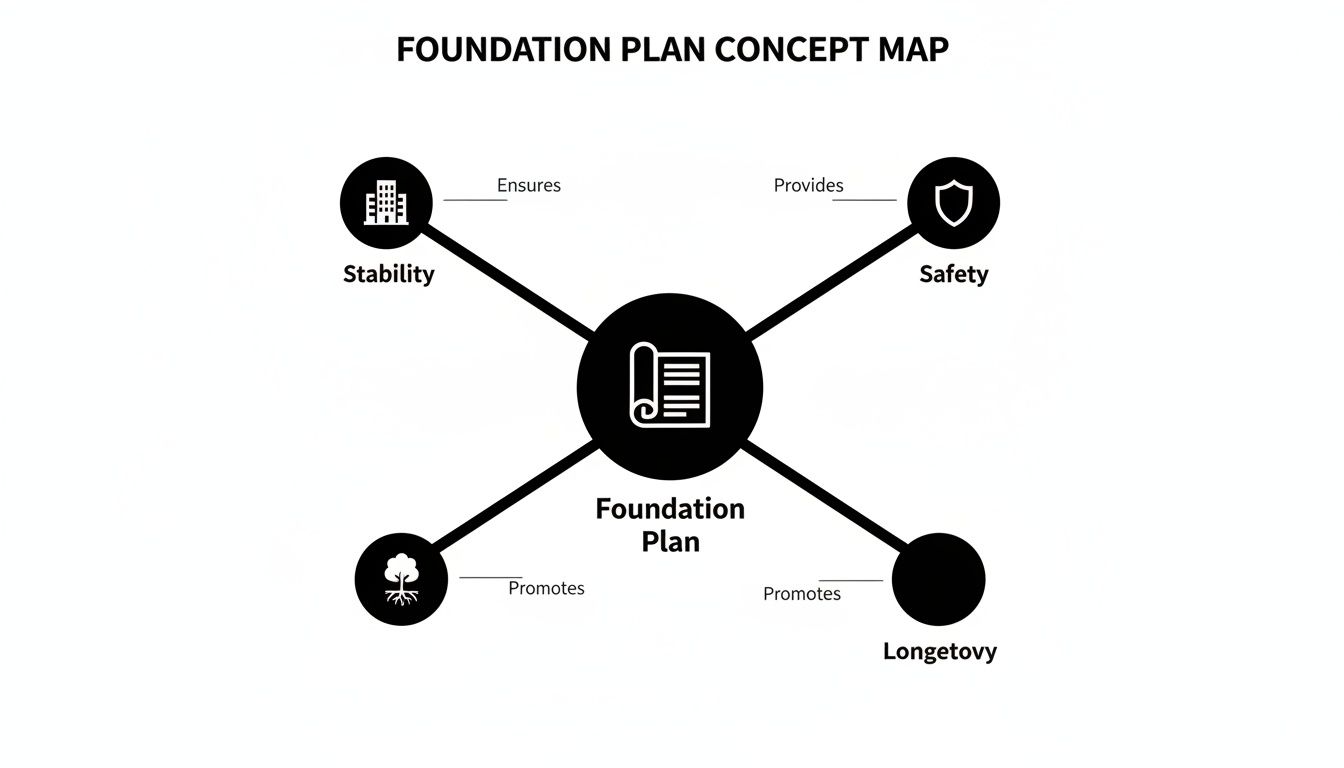
Everything starts here. These three critical outcomes all originate from the detailed instructions outlined in this single blueprint.
Decoding the Main Elements
When you first open the plan, the key is to orient yourself by identifying the main structural elements. These are the key players who collaborate to establish a solid foundation for the entire home.
Let's break down the most common features you'll run into.
Footings: These are literally the "feet" of the house. On the plan, you'll see them as solid or dashed lines running just outside the main foundation walls. They're always wider than the walls because their entire job is to spread the home's weight over a larger patch of soil, preventing it from sinking or shifting.
Foundation Walls: This is the structural backbone of the foundation. They appear as thick, solid parallel lines that outline the perimeter of the home. These walls take the load from the entire house and transfer it down to the footings.
Piers and Beams: Think of these as the foundation's internal skeleton. Piers (or posts) are individual support points, typically represented as small squares or circles within the foundation's outline. Beams are the long, horizontal supports that rest on these piers to carry the weight of the floors above, and they're essential for creating those wide-open living spaces we all love.
Understanding the Symbols and Notes
Beyond the major structural lines, a foundation plan is detailed with symbols and notes that provide the finer details. You don't have to memorize every single one, but knowing what to look for is crucial.
A common mistake is focusing only on the thick lines of the walls and ignoring all the little callouts. Those notes often contain the most vital information, like specs for steel reinforcement (rebar), required concrete strength, and drainage details.
Keep an eye out for these common annotations:
Dimension Lines: These are the thin lines with arrows on each end. They tell you the exact length of walls, the distance between posts, and other critical measurements. No guesswork allowed.
Slab Details: For slab-on-grade foundations, you’ll find notes specifying the slab's thickness (like “4" concrete slab”) and any reinforcing mesh or rebar needed.
Section Marks: Look for a symbol that looks like a circle with an arrow. This is a heads-up that another drawing exists, showing a cross-section—a "slice"—of that specific area, providing a much more detailed view.
By getting comfortable with these core components, you'll be able to interpret what is a foundation plan and have much more productive, informed conversations with your builder and architect.
Choosing Your Foundation: Slab, Basement, or Crawl Space
Not all foundations are built the same, and the type you choose will have a huge impact on your home's final cost, day-to-day function, and even its comfort level. This isn't a decision made on a whim; it's a strategic choice that hinges on your local climate, budget, and how you plan to live in the home. It's a fundamental part of understanding what is a foundation plan—knowing that the blueprints must lock in one of three main options.
The three main options are the slab-on-grade, the full basement, and the crawl space. Each comes with its own list of pros and cons, which is why one might be perfect for a Texas ranch house while another is the go-to for a home in snowy New England.
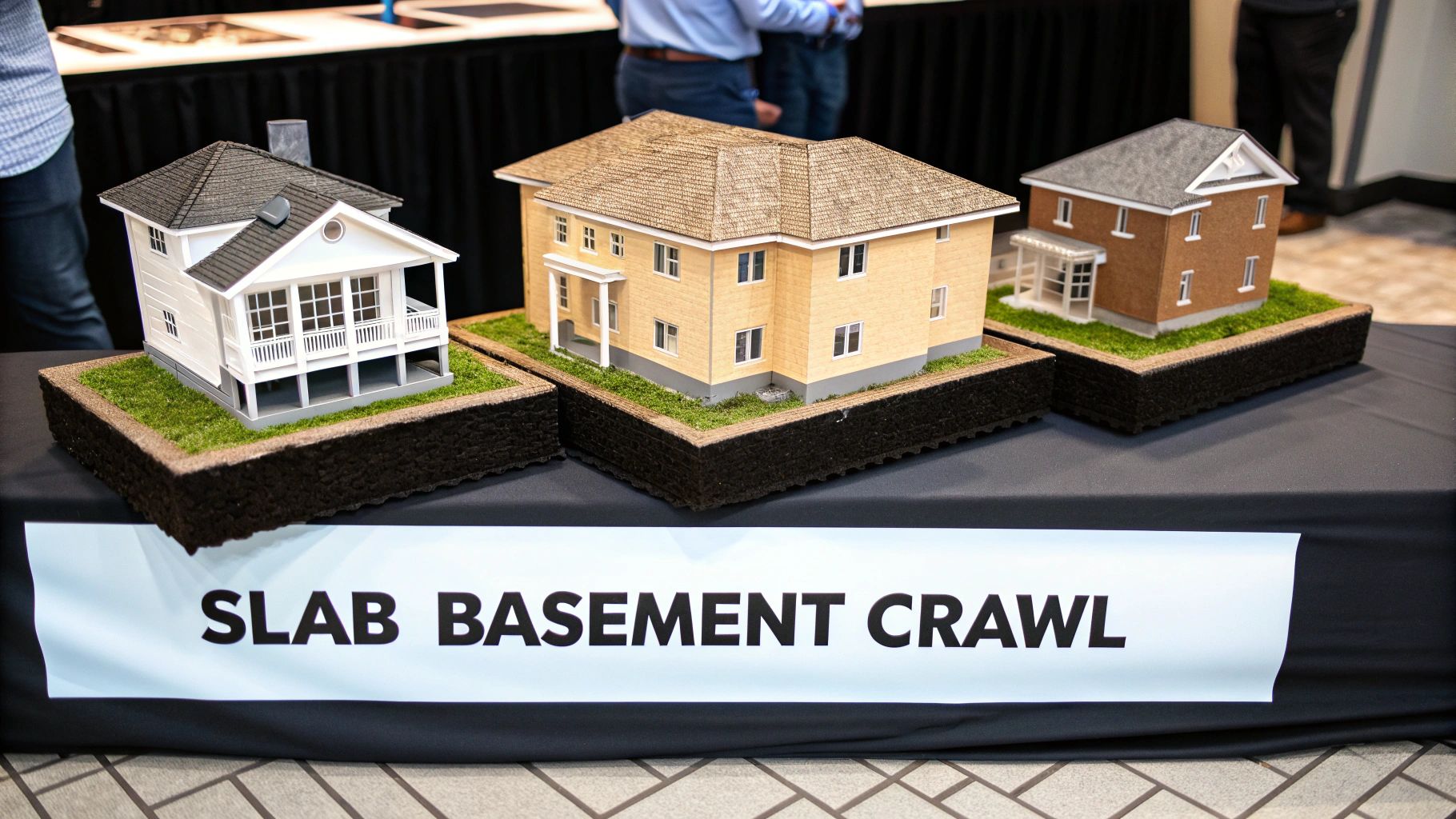
The Slab-on-Grade Foundation
A slab-on-grade foundation is pretty much what it sounds like: a single, thick slab of concrete poured directly onto prepared ground. It's the most straightforward of the bunch and often the most budget-friendly.
You'll see this type of foundation everywhere in warmer climates where the ground doesn't freeze deep enough to cause problems. Since you don't have to do extensive digging, the construction process is faster and requires less labor. If you go this route, it's worth getting familiar with the basics of concrete slab shuttering, which is the framework that holds the concrete in place while it sets.
Slab foundations have become incredibly popular across the U.S. housing market, and for good reason. Experts point out that slabs can significantly reduce costs on labor and materials—often by 20-30% less than alternatives. They're a practical fit for warmer regions where basements might struggle with moisture.
The Full Basement Foundation
Head into colder parts of the country, and the full basement becomes the standard. This approach requires extensive excavation work to place the footings below the local frost line. This is absolutely critical to prevent the ground from freezing, expanding, and causing the whole house to shift.
Sure, it's more expensive and complicated to build, but a basement pays you back with a massive benefit: valuable extra space. You can finish this area to create more living space, a home gym, or a workshop, or leave it unfinished for ample storage.
A full basement can nearly double the usable square footage of a single-story home. For homeowners in areas with high land costs, this makes it an extremely efficient way to maximize living space without increasing the home's footprint.
The Crawl Space Foundation
Think of a crawl space as the middle ground between a slab and a full basement. The house is built up a few feet off the ground, leaving a short, accessible "crawl space" underneath.
That small elevation is a significant advantage in areas with damp soil, as it lifts the home's wooden structure above damaging ground moisture. It also makes it much easier to get to your plumbing, electrical, and HVAC systems for any future maintenance or repairs.
Accessibility: Getting to your utilities is a breeze compared to having them embedded in a concrete slab.
Cost: It generally costs more than a slab but less than digging out a full basement.
Insulation: This space must be properly sealed and insulated to prevent moisture problems and keep your energy bills in check.
To help you visualize the trade-offs, here's a quick comparison of the three main foundation types.
Comparing Foundation Types: Slab vs. Basement vs. Crawl Space
Feature | Slab-on-Grade | Full Basement | Crawl Space |
|---|---|---|---|
Cost | Lowest | Highest | Moderate |
Construction Time | Fastest | Slowest | Moderate |
Climate Suitability | Best for warm climates | Ideal for cold climates (below frost line) | Good for moist or sloped terrains |
Utility Access | Difficult (embedded in slab) | Excellent (fully accessible) | Good (accessible) |
Extra Space | None | Adds significant living/storage space | Minimal storage space |
Moisture Risk | Low (if well-drained) | High (requires waterproofing) | Moderate (requires vapor barrier) |
Ultimately, choosing the right foundation comes down to your priorities and location. Whether you're looking at cost-effective small home plans that are a natural fit for a simple slab or a bigger family home that could really use the extra room a basement offers, your foundation plan will make that critical decision official.
Why a Solid Foundation Plan Is Your Best Insurance Policy
It's easy to view a detailed foundation plan as just another line item on a lengthy list of expenses. But thinking that way is a big mistake. Truthfully, it's one of the best insurance policies you can buy for your construction project. This isn't just a piece of paper; it's a hands-on tool that protects your budget, your timeline, and the quality of your finished home.
Its job starts long before a single shovel hits the dirt. Your local building department will not issue a permit without a professionally stamped foundation plan. This isn’t just red tape—it’s a critical safety check. The plan is the proof they need to demonstrate that your home's design can withstand local soil conditions, comply with structural codes, and account for regional issues such as frost lines or seismic activity.
The Financial Blueprint
Creating an accurate budget without a precise plan is essentially impossible. A detailed foundation plan enables contractors to calculate precisely the quantities of concrete, steel rebar, anchor bolts, and waterproofing materials they'll need. This clarity eliminates the guesswork that often leads to expensive, last-minute surprises.
In today's market, where a new home is a massive investment, you need that level of financial control. A solid plan is how you manage those high stakes, keeping your project on budget and in full compliance. If you're curious about construction spending, you can find great insights in detailed industry outlooks.
Think of the foundation plan as the universal language for your entire construction team. It’s the single source of truth that the architect, structural engineer, excavator, and concrete contractor all follow to execute their roles perfectly.
Preventing On-Site Catastrophes
Having everyone on the same page prevents the kind of misunderstandings that cause disastrous and costly mistakes. When every footing is dimensioned, every support pier is located, and every wall thickness is specified, there’s no room for someone to "just guess."
This level of coordination ensures that:
Excavation is precise: The plan clearly defines the exact depth and width for all footings.
Plumbing is placed correctly: It shows exactly where pipes need to run through the slab or foundation walls.
Structural loads are supported: Beams and posts are positioned exactly where the design requires them to be.
At the end of the day, paying for a high-quality foundation plan isn't about buying a drawing. It’s about buying certainty. It’s the guarantee that your home will be built safely, meet all regulations, stay on budget, and stand strong for generations to come. It’s the best policy against the financial and structural risks of construction, turning a complex process into a clear, manageable project.
Common Foundation Plan Mistakes and How to Avoid Them
Even with a perfect set of blueprints, things can go wrong. We’ve all heard the saying, “An ounce of prevention is worth a pound of cure.” In construction, that’s an understatement. A tiny error on paper can quickly snowball into a massive, eye-wateringly expensive problem in the field.
Knowing the common pitfalls with foundation plans is the key to spotting them before they have a chance to derail your entire project.

Many of these issues stem from treating a stock plan as a one-size-fits-all solution. Every single plot of land is unique—it has its own soil, climate, and topography. A plan designed for the sandy, flat ground in Florida will fail spectacularly on a clay slope in Ohio.
Ignoring Local Site Conditions
Probably the most frequent—and most damaging—mistake is failing to adapt the plan to your specific lot. A standard foundation plan has no idea about your property’s unique challenges.
Soil Type: Different soils can hold wildly different amounts of weight. Your plan must be adjusted based on a professional geotechnical report that analyzes your soil’s load-bearing capacity to prevent the house from settling or cracking.
Frost Line Depth: In colder climates, footings have to be placed below the local frost line. If they’re too shallow, the ground will freeze, heave the foundation upward, and cause severe structural damage.
Water Table and Drainage: Ignoring how water moves on your property is a recipe for disaster. A high water table or poor natural drainage can lead to a perpetually wet basement or a cracked, compromised slab.
A professional foundation plan is never truly "finished" until it has been reviewed and adapted by a local engineer. This crucial step ensures the design is perfectly suited to your specific site, not just a generic ideal.
Misinterpreting or Overlooking Details
The second major category of mistakes comes from simply not reading the plan carefully enough. Every line, number, and note is there for a reason, and glossing over the details can lead to critical failures down the road.
Here are a few key details that often get missed:
Incorrect Dimensions: Double- and triple-checking every single measurement is vital. A footing or anchor bolt that’s off by just a couple of inches can throw off the entire framing process that follows.
Inadequate Reinforcement: The plan will specify the exact size and spacing of steel rebar. Using less rebar (or the wrong size) to cut costs is a common mistake that compromises the entire structure and poses a significant safety risk.
Poor Drainage Specifications: Good plans include details for perimeter drains, waterproofing membranes, and proper grading to slope the earth away from the house. Failing to install these systems correctly from the start can lead to persistent water intrusion—a problem that is incredibly difficult and expensive to fix later on.
The best way to sidestep these problems is to treat your foundation plan as a pre-flight checklist. Sit down with your builder and engineer and review every note and dimension before any dirt gets moved. Ask questions about anything you don’t understand. This proactive approach is your best defense against future headaches and ensures your project starts on a truly solid footing.
From Blueprint to Reality: Building with Confidence
Every home's journey starts below ground, where the foundation plan translates a dream into a solid, buildable structure. This isn't just a simple drawing; it's a detailed set of instructions outlining precise dimensions, footings, materials, and support locations.
Think of it as the ultimate roadmap for your builder. It details everything from the slab's thickness and the height of the walls to the specific grade of steel rebar needed. It’s also where you’ll see the decision made on whether your home will have a slab-on-grade, basement, or crawl space foundation.
What are the key takeaways from a foundation plan?
It defines the layout for footings and walls, which is crucial to achieving structural stability.
It specifies all the materials, like the required concrete strength and steel rebar grade.
It outlines drainage solutions to protect your home from water damage in the future.
When everyone—from the builder to the city inspector—is working from a single, authoritative guide, it brings a sense of order to the chaos of construction. This alignment is what prevents costly mistakes and keeps a project on track, both in terms of time and money.
A solid foundation plan is the bridge between imaginative design and safe, sound construction.
Build with Confidence
As you move from the blueprint phase to the actual build, finding reliable residential foundation concrete services becomes one of your most important next steps. It's the moment your plan starts to take physical form.
If you're still searching for the ideal layout, feel free to browse our collection of professionally designed homes.
Explore our single-story home plans to discover designs that seamlessly blend aesthetic appeal with the robust foundation details we've been discussing. You can start your build with the confidence that comes from knowing every single measurement and specification has been accounted for.
Your future home deserves that clarity.
Your Top Questions About Foundation Plans
Jumping into the world of home construction can bring up a lot of questions. That’s especially true when you start looking at the foundation plan—literally the bedrock of your entire project.
We get a lot of common queries from home buyers and builders just like you. Let's address some of the most common ones so you can move forward with confidence.
Does Every House Plan Come with a Standard Foundation Plan?
Most stock house plans you find will include a default foundation type, such as a slab or a basement, that’s designed for a fairly standard building situation. Think of it as a solid starting point, not the final word.
Here’s the critical part: this standard plan must be reviewed and almost always modified by a local engineer. They are the ones who adapt it to fit your specific location, climate, and local building codes before a single shovel of dirt can be moved.
Can I Change the Foundation Type of a House Plan?
Yes, in most cases, you absolutely can. For instance, a plan that originally shows a crawl space can often be converted to a full basement or a slab-on-grade foundation. It's a common request.
This isn't a DIY change, though. A qualified local professional must perform the modification. An engineer or architect will need to redraw the plan to ensure the home remains structurally sound and meets all the requirements of your local building department.
Never assume a foundation plan is a "one-size-fits-all" document. A local engineer’s stamp of approval is the critical step that customizes the plan to your specific property, turning a generic blueprint into a site-specific guide.
Who Is Responsible for Ensuring the Plan Is Right for My Property?
While the original architect provides the design, the homeowner and their builder are ultimately responsible for making sure the foundation plan is correct for the actual building site.
This responsibility is almost always fulfilled by hiring a local structural engineer. They'll review, approve, and stamp the plan, making the necessary adjustments for your soil type, the slope of your lot, and other site-specific factors that the original designer may not have been aware of.
At RBA Home Plans, we provide clear, professionally designed blueprints to give you the strongest possible start. Explore our diverse collection of home plans to find a design with a solid foundation for your future. Visit us at https://rbahomeplans.com to learn more.


Comments