
A Guide to In-Law Suite Plans for Multigenerational Living
- Jan 9
- 17 min read
Updated: Jan 16
If you've ever thought about adding a separate living space to your property for family, you've probably heard the term in-law suite plans. These are the professional architectural blueprints you need to build a secondary living space, often referred to as an Accessory Dwelling Unit (ADU), directly on your own property.
Think of these plans as the complete roadmap for building a self-contained home. They’re the perfect solution for multigenerational families who want to stay close but still enjoy their own independence.
What Is a Modern In-Law Suite?
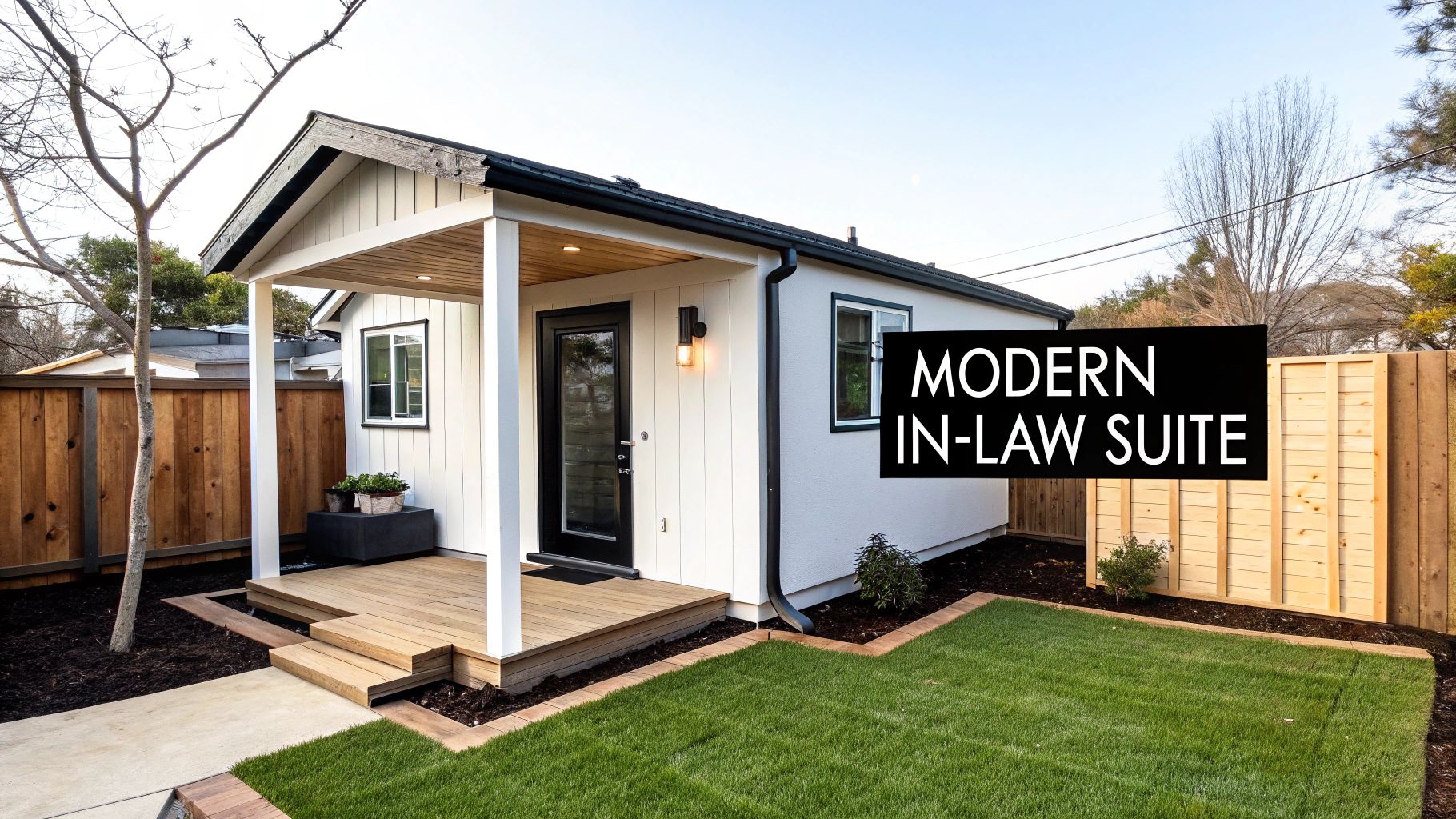
Forget the old idea of just a spare bedroom in the basement. Today’s in-law suite has evolved into a thoughtful, modern living solution. It’s a private, fully functional home within a home. It’s less of an "addition" and more like a separate, smaller house conveniently located just steps away.
This shift comes from a growing desire for multigenerational living. Families want to stay connected, but not at the cost of personal space. These suites—also known as granny flats or ADUs—strike that perfect balance. They let aging parents live nearby, give adult children a head start, or offer a flexible space for guests.
Many modern in-law suites are specifically designed to support the concept of aging in place, enabling our loved ones to remain independent and comfortable in a familiar, supportive environment.
From Concept to Construction
An idea for an in-law suite is one thing, but making it a reality all comes down to having a solid plan. Professional, construction-ready in-law suite plans are the absolute first step. These blueprints are more than just sketches; they are detailed documents that guide every single aspect of the building process.
A well-crafted plan is your guarantee that the finished home will not only look great but also be safe, functional, and fully compliant with local building codes. Here are a few key benefits of starting with professional plans:
Clarity and Precision: Good plans lay out every detail, from room dimensions to electrical wiring, leaving no room for guesswork.
Budget Control: A detailed blueprint enables you to obtain accurate, competitive quotes from contractors, which helps prevent unexpected costs down the line.
Regulatory Compliance: Professional plans are created to meet building codes, making the entire permit approval process much smoother.
Functional Design: They turn your vision into a truly livable space that maximizes comfort, privacy, and accessibility for whoever will be living there.
At the end of the day, an in-law suite plan turns the abstract goal of “more space for family” into a real, buildable project. It’s the foundational document that makes sure your investment results in a high-quality, lasting home.
Ultimately, choosing the right plan is the first and most important decision you'll make. It provides the structure you need to create that perfect blend of independence and connection for your family.
Finding the Right In-Law Suite Layout
Selecting the right layout for your in-law suite is akin to choosing the right tool for a job. The best option really depends on what you’re trying to accomplish, the layout of your property, and your family’s unique needs. When it comes to in-law suite plans, you’re generally looking at two main categories: attached units and detached units. Each one strikes a different balance between convenience and privacy.
An attached suite is a living space that shares at least one wall with your primary home. Think of it as a seamlessly integrated apartment. This could be a converted garage, a finished basement, or a new addition built right onto the side of your house. These are often quicker and more affordable to build because they can sometimes tap into your home's existing plumbing and electrical systems.
A detached suite, on the other hand, is a completely separate structure. You might hear it referred to as a backyard cottage, casita, or granny flat. It's essentially a small, standalone home on your property that offers the absolute most privacy for everyone involved.
Attached Suites: Convenience And Connection
The biggest advantage of an attached suite is proximity. If you’re building a space for an aging parent who needs daily help, an attached layout is almost always the most practical choice. It gives you easy, covered access between the two homes, which is a huge benefit in bad weather or for those late-night check-ins.
Here are a few common ways to create an attached suite:
Garage Conversions: This is a popular and budget-friendly route. Since the foundation and exterior walls are already in place, a garage conversion can save you thousands of dollars in construction. They’re a great way to create an accessible, ground-floor unit.
Basement Apartments: If your home features a walk-out basement, converting it into an in-law suite can be a fantastic way to utilize that space. The key is to maximize natural light and ensure it has a private entrance, making it feel less like a basement and more like a real home.
Bump-Out Additions: This refers to building a new structure that is connected to your main house. It offers you significantly more design flexibility than a conversion, allowing you to create a custom layout that’s perfectly suited to your family.
For families who value daily caregiving, shared meals, and easy interaction, attached in-law suite plans offer a perfect blend of togetherness and personal space. The connection fosters a sense of unity while still giving everyone a private retreat.
Detached Suites: Privacy And Future Flexibility
For the ultimate in privacy and independence, nothing beats a detached unit. By creating a separate backyard home, you give the occupant a true sense of their own space, which can be a game-changer for maintaining healthy family dynamics. The physical separation minimizes noise and day-to-day disruptions for both households.
This layout is also incredibly flexible in the long term. A detached suite built for a parent today could easily become a home for an adult child tomorrow, a guest house for visitors, or a high-demand rental unit that generates passive income. This versatility often leads to a higher return on investment and can boost your property value by as much as 35% in some areas.
The main trade-off, of course, is the cost. Building a completely new structure requires a separate foundation, new utility hookups, and full exterior construction, making it the most expensive option. For those who can swing the initial investment, though, the long-term benefits are often well worth it.
To help you visualize the differences, let's compare the most common layouts side by side.
Comparing Common In-Law Suite Layouts
This table breaks down the key features, best-use cases, and primary considerations for the main types of in-law suite plans.
Layout Type | Key Features | Best For | Potential Challenges |
|---|---|---|---|
Attached: Garage Conversion | Uses existing structure; often single-level and accessible. | Budget-conscious projects; creating a ground-floor unit for someone with mobility needs. | Loss of garage/parking space; potential for limited natural light. |
Attached: Basement Apartment | Utilizes existing lower-level space; often has a private entrance. | Homes with walk-out basements; families wanting separation within the main house. | Moisture control is critical; can feel dark without proper design; ceiling height limitations. |
Attached: Bump-Out Addition | New construction connected to the home; fully customizable. | Creating a perfect, custom-designed space when budget is less of a concern. | Higher cost and longer construction time than conversions. |
Detached: Backyard Cottage | Separate, standalone structure; complete privacy. | Maximizing independence and rental potential; families who want clear boundaries. | Highest upfront cost; requires separate utility hookups and more complex permits. |
Ultimately, the best layout is the one that fits your family's immediate needs and your long-term goals for your property. By carefully weighing these pros and cons, you can find a plan that creates a comfortable, functional, and valuable addition to your home for years to come.
Navigating Zoning Laws and Building Permits
Before you even think about breaking ground, the most important part of your in-law suite project involves paperwork. Navigating local zoning ordinances and building permits can feel overwhelming, but getting it right is crucial to a smooth building process. These rules are in place to ensure safety, manage neighborhood density, and protect property values for everyone involved.
Think of zoning laws as the basic "what and where" rules for your property. They determine what kind of structures you can build (such as an Accessory Dwelling Unit, or ADU) and exactly where on your lot it can be situated. You'll encounter terms like setbacks (the distance your building must be from the property lines) and lot coverage (the maximum percentage of your land that can be covered by buildings).
Understanding the Local Rulebook
Every town, city, and county operates according to its own rules. What works for a friend one town over might be completely off-limits for you. That’s why your very first step should be a call or visit to your local planning and building department. Getting in touch before you've spent money on a design will save you a world of headaches and costly changes later on.
To ensure your in-law suite is compliant, it helps to have a basic understanding of architectural zoning principles. This knowledge will help you ask the right questions and make sense of the official answers you receive.
This handy decision tree can help you visualize whether an attached or detached in-law suite plan is the better fit for your specific needs.
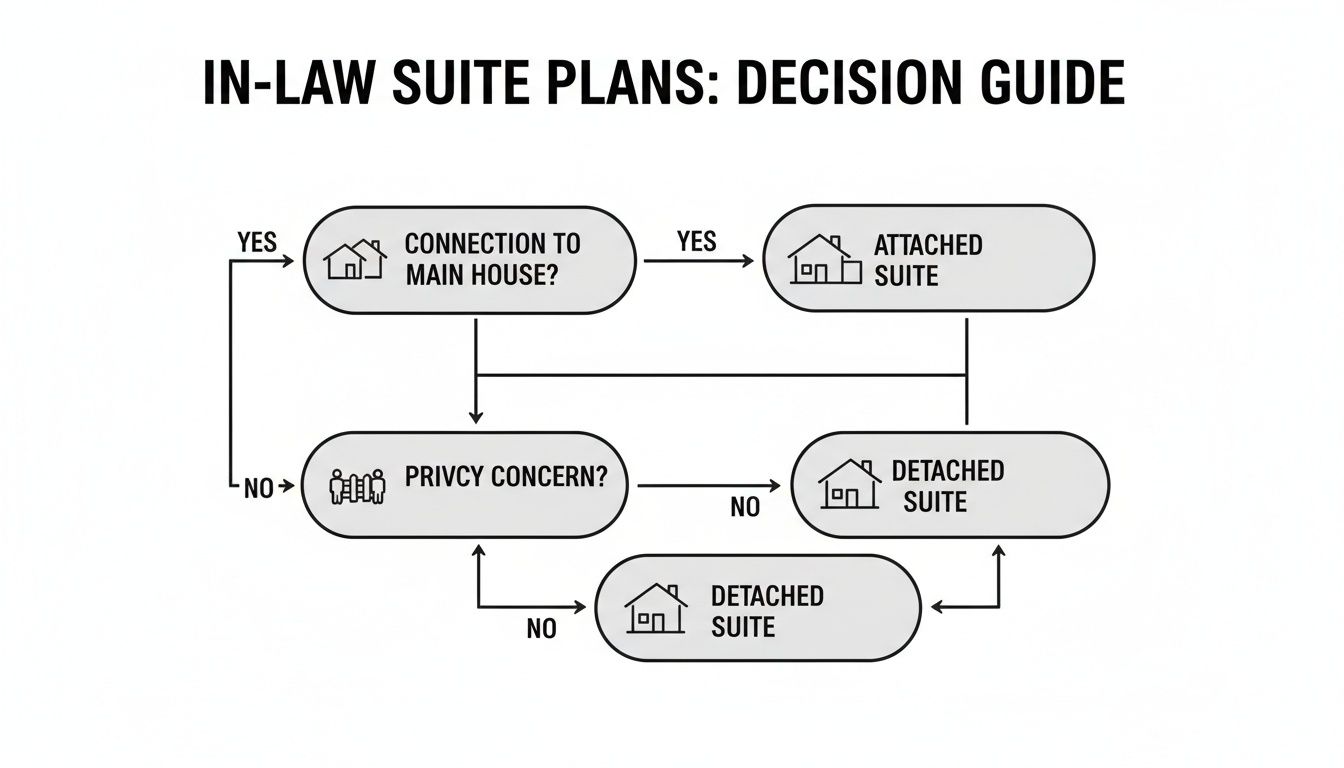
As you can see, the choice often comes down to balancing the need for a close connection with the desire for more privacy.
The Power of Professional In-law Suite Plans
This is where having a set of professional, builder-ready in-law suite plans gives you a huge advantage. When you walk into the planning office with detailed, accurate blueprints that already factor in standard building codes, it shows you’re serious and have done your homework. It’s a world away from scribbling an idea on a napkin.
That professional first impression can make all the difference. Officials are more likely to work with you as a partner, which helps the review process go much more smoothly. A complete set of plans is a universal language that clearly communicates every technical detail, leaving no room for confusion.
Across the board, unclear or flawed design documents are a major source of conflict. In fact, studies show that design-related mistakes or ambiguities are a factor in roughly 30–40% of construction legal claims by value. It just goes to show how crucial it is to have clear, professional architectural plans.
Your Permit Application Checklist
Being prepared for the planning department is half the battle. If you have your questions ready, you’ll walk out with the clear answers you need to move forward with confidence.
Here are the essential questions to ask your local officials:
Zoning Verification: "Is my property zoned to allow for an Accessory Dwelling Unit (ADU) or in-law suite?"
Size and Height Limits: "Are there any minimum or maximum square footage requirements or height restrictions?"
Setback Requirements: "What are the required distances from the front, side, and rear property lines for a new structure?"
Parking Regulations: "Will I need to add another off-street parking space for this new unit?"
Utility Connections: "What are the rules and fees for connecting to public water, sewer, and electricity?"
Getting these answers upfront helps you choose an in law suite plan that you know will be approved from the get-go. For a more detailed look, check out our guide on mastering the building permit process. Ultimately, a compliant set of plans is your most effective tool for ensuring a predictable and successful project.
Designing for Long-Term Accessibility
Since in-law suites are often built for aging parents or family members, thinking about accessibility isn't just a nice touch—it’s absolutely essential. Getting this right from the start ensures the space is safe, comfortable, and empowering for the long haul.
This forward-thinking approach is often referred to as universal design. The whole idea is to create a home that works for everyone, regardless of their age or ability, without requiring numerous clumsy adaptations later on.
Weaving these principles into your initial in law suite plans is far smarter and more affordable than trying to retrofit things down the road. It’s all about creating a home that adapts as needs change, not one that eventually becomes a source of frustration. When you plan for accessibility from day one, you’re building in dignity and independence.
Creating a Foundation of Safety
The most powerful accessibility features are usually the ones you don't even notice until you really need them. Think of these as the non-negotiables for your design.
Zero-Step Entry: If there's one thing to get right, it's this. A smooth, level entrance from the outside is a game-changer. Eliminating even a single step removes a huge barrier for anyone using a wheelchair, a walker, or who has trouble with stairs. A gently sloped walkway is the perfect solution.
Wider Doorways and Hallways: Standard doorways are often a tight squeeze for mobility aids. Ensure your plans include 36-inch-wide doorways to provide everyone with comfortable clearance. For hallways, aim for at least 42 inches wide so there’s plenty of room to turn and move around easily.
Single-Story Layout: Whenever possible, stick to a single-level design. This completely eliminates the risk of falls, which are unfortunately a common occurrence among older adults on stairs.
Universal design isn't about making a space feel like a hospital. It's about smart, subtle choices that make a home more comfortable and functional for everyone, no matter their age or physical ability.
Designing Functional Kitchens and Bathrooms
The kitchen and bathroom are the most frequently used areas in any home, and thoughtful accessibility planning can have the greatest impact here. Even small tweaks to your in-law suite plans can significantly enhance safety and usability.
A well-designed bathroom is absolutely critical for preventing accidents. Consider these modifications:
Roll-In or Curbless Shower: A zero-threshold shower is a fantastic option. It lets a wheelchair roll right in and gets rid of the tripping hazard of a shower curb. Be sure to include a built-in bench and a handheld showerhead for extra comfort and safety.
Grab Bar Reinforcement: Here’s a pro tip: even if you don't install grab bars right away, have your builder put extra wood blocking inside the walls around the toilet and shower. This makes it incredibly easy to securely add them later on.
Comfort-Height Toilet: Toilets that are just a bit taller (17-19 inches) are much easier to use for anyone with knee or back problems.
In the kitchen, consider lowering countertops from the standard 36 inches to around 34 inches, making them much more usable from a seated position. Simple additions like pull-out shelving in lower cabinets and easy-to-grasp lever-style handles on faucets and doors also make the space feel effortless to use.
If you're looking for more ideas, our aging-in-place home modifications guide is packed with practical tips. By planning ahead, you can ensure your in-law suite is more than just a building—it's a supportive, welcoming home for years to come.
Budgeting for Your In-Law Suite Project
Let's talk about the financial side of things. Nailing down a clear, realistic budget is probably the most critical step you'll take. Think of it as the foundation for your whole project—it turns your ideas into a solid plan and helps you avoid those nasty, expensive surprises down the road.
The final price tag will swing pretty wildly depending on what you're building. A simple garage or basement conversion is usually the most wallet-friendly option. On the other hand, a brand-new, detached unit is a much bigger investment. Each path has its own financial roadmap.
Key Cost Drivers to Consider
Building an in-law suite is a lot more than just lumber and nails. It’s a mix of materials, skilled labor, and all the administrative fees that add up. To get your budget right, you have to account for every one of these pieces.
Here are the main expenses to factor in:
Permits and Fees: Before a single shovel hits the dirt, you'll need to pay for building permits, zoning applications, and maybe even impact fees. These can easily add up to several thousand dollars.
Site Preparation: For a detached ADU, this means grading the land, clearing trees, and pouring a new foundation. Even for a conversion, you might have demolition or structural assessment costs.
Materials: This is everything from the concrete and framing lumber to the roofing, windows, and insulation. The quality of materials you choose will have a huge effect on your budget.
Labor: This is often the biggest chunk of the budget. It covers the framers, electricians, plumbers, roofers, and all the other skilled tradespeople who bring your suite to life.
Finishes and Fixtures: This is the fun part where your style comes in. Costs for flooring, paint, cabinets, countertops, appliances, and lighting can vary dramatically depending on your tastes.
How In-Law Suite Plans Control Your Budget
Starting with a detailed, locked-in set of in law suite plans is the single best way to keep your money in check. Your architectural plans aren't just a design document; they're your primary financial controller. They give contractors a precise blueprint, allowing them to give you accurate bids based on the exact same specs.
This clarity is your best defense against scope creep—that sneaky process where small changes and "while you're at it" additions slowly blow up your budget. A complete plan locks in the design from the start, stopping those budget overruns before they can even happen.
In today's market, a detailed architectural plan isn't just for builders—it's a critical financial document. It lets you lock in contractor bids, secure financing, and manage the risk of rising costs right from the beginning.
The volatility in building costs and the long approval cycles we're seeing now are exactly why clear, construction-ready home plans are so essential. International surveys consistently point to cost escalation and scope changes as top reasons for conflict in construction. In this kind of environment, detailed plans that nail down square footage and material specs are your key to locking in bids and getting your financing approved. You can learn more about the factors influencing construction costs and property trends.
Common Financing Strategies
Not many homeowners can pay for an entire in-law suite project with cash. Luckily, there are a few common ways to fund your build. Each one has its pros and cons, so you'll want to pick the one that fits your financial picture.
Home Equity Loan (HEL) or Line of Credit (HELOC): If you've got equity built up in your main house, you can borrow against it. A HEL gives you a lump sum with a fixed interest rate, which is great for predictable budgeting. A HELOC is more like a credit card with a variable rate, giving you the flexibility to draw money as you need it.
Cash-Out Refinance: This means you replace your current mortgage with a new, larger one and get the difference in cash. This can be a great move if you're able to lock in a lower interest rate than what you have now.
Construction Loan: These are short-term loans designed specifically for building projects. The bank usually releases funds in stages as different parts of the construction are completed. Once the build is finished, the loan typically converts into a standard mortgage.
Figuring out the right financing is a big deal. It’s always a good idea to chat with a financial advisor to go over your options and find the path that makes the most sense for you and your long-term goals. With a solid budget and a clear financing plan, you'll be in a great position to make your in-law suite a reality.
Finding and Customizing Your Ideal Home Plan
Going from a vague idea in your head to a real-life project all starts with finding the right set of blueprints. Think of a professional catalog of in-law suite plans like a gallery of proven concepts. You’re not starting from a blank page; you’re starting with builder-ready designs that have already solved all the tricky structural puzzles. This simple step saves you a ton of time and money right out of the gate, letting you focus on what really matters: finding a layout that just feels right.
The first part of the search is all about matching a plan to your basic needs. Most plan providers, including us at RBA Home Plans, have easy-to-use search filters to help you narrow down the choices. You can sort by essentials like square footage, number of bedrooms and baths, and even the overall style—whether you’re looking for a classic ranch or a cozy little cottage. It’s the best way to find a solid foundation that works for your property, budget, and family.
Making a Stock Plan Your Own
One of the biggest myths about pre-designed plans is that they’re set in stone. The truth is, a good stock plan is just a fantastic starting point. It’s like buying a great suit off the rack—the basic cut is perfect, but you’ll want to get it tailored for that perfect, custom fit. Our plans are specifically designed with modifications in mind.
This flexibility is what makes all the difference, because every family’s needs are a little bit different. A standard layout might be 90% of what you want, but that last 10% is what makes a house feel like your home.
Customizing a pre-designed plan really gives you the best of both worlds. You get the proven, cost-effective layout of a stock plan and the personal touch of a custom home. It’s a smart shortcut to getting a space that’s uniquely yours.
Common Modifications to Consider
The ability to tweak in-law suite plans is what closes the gap between a pretty good design and your perfect one. A design firm can work with you on small changes that have a huge impact on how the space lives and feels.
Here are a few of the most common customizations we see:
Accessibility Enhancements: This is a big one for multi-generational homes. We often widen doorways to 36 inches, design zero-threshold roll-in showers, or adjust kitchen counter heights for comfortable wheelchair access.
Kitchen and Bath Layouts: Maybe you want to move things around to fit a bigger kitchen island for Sunday brunch, or perhaps you need a double vanity in the bathroom to keep the peace.
Window and Door Placements: Need to capture more morning sun in the living room? Or maybe a door needs to shift to work better with your backyard layout? These are straightforward changes that can completely change the feel of a room.
Material and Finish Specifications: The plans can be updated to call out specific materials you love, from exterior siding that perfectly matches the main house to the exact type of flooring you’ve picked out.
At the end of the day, choosing and adapting a plan is a team effort. For more ideas, check out our guide to the top two-family home plans for multi-gen living. Just remember, you’re not just buying a blueprint—you’re investing in a flexible starting point to create a home your family will love for years to come.
Common Questions About In-Law Suite Plans
As you get closer to making a final decision, it's totally normal for a few big questions to pop up. Let's tackle the most common things homeowners ask about in law suite plans, property value, legal rules, and how long it all takes. Getting clear answers here can give you the confidence you need to move forward.
How Much Value Does an In-Law Suite Add to a Home?
This is usually the first question on everyone's mind, and for good reason. A well-designed in-law suite, especially one legally classified as an Accessory Dwelling Unit (ADU), can seriously boost your home's value. In many areas, you could see an increase of 25% to 35%.
Of course, the final return on your investment comes down to a few things:
Quality of Construction: Using high-quality materials and a professional builder will always pay off in the long run.
Layout and Amenities: A detached unit with its own private entrance, a full kitchen, and its own laundry is the gold standard for buyers.
Rental Potential: If your local laws allow you to rent out the unit, it becomes an income-generating asset, which is a huge plus for future buyers.
In short, an in-law suite adds more than just square footage. It adds flexibility, marketability, and a potential new stream of income, making it a powerful financial investment.
Can I Legally Build an In-Law Suite on My Property?
The answer here depends entirely on your local town or city's zoning rules and building codes. Whether you can build isn't a simple "yes" or "no"—it's all about what's allowed in your specific area.
Officials will look at things like your property’s zoning district, your total lot size, setback requirements (how far you have to be from property lines), and any specific ADU regulations. The first, most critical step is to call your local planning or building department before you spend any money. Using a professional, code-compliant in law suite plan is key to making the permit process go smoothly.
What Is the Difference Between an In-Law Suite and an ADU?
People often use these terms interchangeably, but they have important legal differences you need to know about.
An in-law suite is really just a casual, catch-all term for any private living space you create for a relative. It could be anything from a simple basement conversion to a brand-new addition.
An Accessory Dwelling Unit (ADU), on the other hand, is a specific legal term. It refers to a secondary, self-contained home on the same lot as a primary house. To be a legal ADU, a unit typically must have its own separate entrance, kitchen, and bathroom.
So, while every legal ADU can work as an in-law suite, not every in-law suite will meet the strict local rules to be classified as an ADU. This distinction is crucial, especially if you ever plan to rent the space out.
How Long Does It Take to Build an In-Law Suite?
The timeline can really vary depending on how complex your project is.
Planning and Permitting: This first part of the process can take anywhere from 2 to 6 months.
Construction: Once you have your permits, the build time itself changes. An interior conversion might take 2-4 months, a garage conversion 3-5 months, and a new detached unit could take 6 to 12 months or even longer.
Starting with a complete, construction-ready plan is the best way to keep delays to a minimum during both permitting and building. It just makes sure everyone is on the same page from day one.
Ready to find the perfect blueprint for your family? At RBA Home Plans, we offer a diverse catalog of construction-ready in law suite plans designed to meet modern needs for flexibility, comfort, and style. Explore our designs and take the first step toward creating your ideal multigenerational living space at https://rbahomeplans.com.


Comments