
Top Questions to Ask Your Home Builder Before You Sign in 2025
Updated: Oct 15, 2025
Building your dream home is one of the most significant investments you'll ever make. The difference between a smooth, exciting journey and a stressful, budget-breaking ordeal often comes down to one thing: asking the right questions upfront. Choosing a home builder is more than just selecting a contractor; it's about finding a partner to bring your vision to life. To ensure you're entering this partnership with confidence and clarity, it's essential to dig deeper than the glossy brochures and model homes.
This guide provides a comprehensive list of crucial questions to ask your home builder, designed to uncover everything from hidden costs and realistic timelines to warranty details and communication protocols. Each question is structured to give you actionable insights, helping you understand the builder's process, experience, and what's included in their standard package versus what costs extra.
By arming yourself with this knowledge, you can vet potential builders effectively, avoid common pitfalls, and lay the foundation for a successful build that meets your expectations and your budget. Let's get started on building not just a house, but a home you'll love for years to come, with the peace of mind you deserve.
1. What is included in the base price and what costs extra?
Of all the questions to ask a home builder, this is arguably the most critical for managing your budget and expectations. The advertised "base price" is rarely the final price. It typically covers the home's essential structure, land (in some cases), and a standard package of finishes, but leaves out many features that buyers consider essential. Understanding this distinction from day one prevents costly surprises down the road.
Think of the base price as the starting line. It often includes builder-grade carpeting, basic laminate countertops, and standard-issue light fixtures. Upgrades like hardwood floors, quartz countertops, recessed lighting, or even the third bay in a garage will be considered add-ons. For instance, national builders like Lennar or D.R. Horton may advertise an attractive entry price, but their design center upgrades can increase the final cost by 15-30%.
Actionable Tips for Clarity
To gain a true understanding of the total cost, take these proactive steps:
Request an Allowance Sheet: Ask for a detailed, itemized list that shows what is standard versus what is an upgrade. This should cover everything from flooring and paint to faucets and doorknobs.
See a "Base Model" Home: If possible, ask to tour a completed home built with only standard, base-price features. This provides a realistic visual of what your money buys at the starting price.
Clarify HVAC and Systems: The included heating and cooling system is a major component. Ask what type of unit is standard and what upgrades are available. You can even compare the costs of different heating and cooling systems to make an informed decision on potential upgrades.
Discuss "Soft Costs": Confirm whether permits, architectural fees, engineering reports, and soil tests are included in the base price or billed separately. These costs can add thousands to your budget.
2. What is your construction timeline and what factors might delay completion?
Among the most important questions to ask a home builder, this one is crucial for planning your move, coordinating the sale of your current home, and managing temporary housing. A realistic timeline reveals the builder's project management skills, experience, and transparency about potential setbacks. Understanding this schedule from the outset helps you prepare financially and logistically for the entire process.
Construction timelines can vary dramatically. Production builders like Pulte Homes might complete a spec home in 4-6 months due to streamlined processes, while a luxury custom builder could take 18-24 months for a complex architectural design. Factors like weather, permit approvals, and material availability can also have a significant impact. For instance, the supply chain disruptions from 2021-2022 often added two to six months to typical build times, highlighting the importance of discussing potential hurdles upfront.
Actionable Tips for Clarity
To get a firm grasp on the construction schedule and prepare for potential shifts, take these proactive steps:
Request a Detailed Schedule: Ask for a comprehensive construction schedule with key milestones. This should outline each phase, from foundation and framing to drywall and final finishes.
Discuss Potential Delays: Inquire about the most common causes of delays they've experienced. This could include subcontractor availability, local permitting backlogs, or seasonal weather impacts like winter freezes or heavy rain.
Set Communication Expectations: Ask how frequently you will receive progress updates and how schedule adjustments will be communicated. A weekly email or phone call is a reasonable expectation. You can see a detailed breakdown of the stages in a house construction timeline to better understand the process.
Plan a Buffer: Never plan your move-in date for the exact estimated completion date. Smart buyers add a buffer of at least 30-60 days to account for unforeseen circumstances and avoid the stress of last-minute housing arrangements.
3. What warranty coverage do you provide and what does it cover?
Your home is a significant investment, and a builder's warranty is the primary protection for that investment against construction defects. This is a critical question to ask a home builder because the warranty reflects their confidence in their own workmanship. A comprehensive warranty provides peace of mind, while a weak one could leave you responsible for costly repairs shortly after moving in.
Most reputable builders offer a multi-tiered warranty, often called a "1-2-10" warranty. This typically includes a one-year warranty on workmanship and materials (like paint and drywall), a two-year warranty on systems like plumbing and electrical, and a ten-year warranty on major structural components. For example, David Weekley Homes provides a one-year comprehensive warranty followed by extended structural coverage, while builders like KB Home partner with third-party providers such as 2-10 Home Buyers Warranty for their 10-year structural guarantee.
Actionable Tips for Clarity
To fully understand what you're getting, you must dig into the details of the warranty agreement:
Get It All in Writing: Never rely on verbal promises. Request a complete copy of the warranty document and review it carefully before signing any contracts. Before finalizing your contract, you'll want to thoroughly review any important warranty information to understand your rights and the builder's obligations.
Clarify Exclusions: Pay close attention to what is not covered. Common exclusions include landscaping, household appliances (which have their own manufacturer warranties), and issues arising from normal wear and tear or homeowner negligence.
Understand the Claims Process: Ask for the specific steps to file a claim. Is there a dedicated warranty department or do you call the main office? Knowing the typical response time and procedure ahead of time will save you stress if an issue arises.
Ask About Past Claims: Inquire about the builder's history with warranty claims. A builder who is transparent and proud of their customer service record will often share this information, signaling they stand behind their work.
4. Can I see examples of your previous work and speak with past clients?
A builder’s portfolio is more than just a marketing tool; it’s a direct reflection of their quality, craftsmanship, and reliability. This question allows you to move beyond glossy brochures and see the real-world results of their work. A reputable builder will be proud to showcase their completed homes and connect you with satisfied homeowners, while any hesitation to do so should be considered a significant red flag.
Seeing is believing, and this step provides invaluable, unfiltered insight. Many production builders maintain lists of recently completed homes for tours, while established custom builders like Arthur Rutenberg Homes actively encourage visits to past projects. This firsthand verification helps you assess everything from the neatness of paint lines to the overall sturdiness of the construction, confirming that their standards align with your expectations.
Actionable Tips for Clarity
To get the most out of your due diligence, follow these targeted steps:
Request a Varied List: Ask to see homes that are similar in style, size, and price point to your desired build. Also, request references for projects completed one to two years ago to see how the materials and workmanship have held up over time.
Visit an Active Job Site: Observing a project in progress offers clues about the builder’s organization and professionalism. A clean, orderly site often indicates a well-managed project and respect for the property.
Prepare Questions for References: When speaking with past clients, go beyond "Are you happy?" Ask specific questions like, "Was the project completed on time and on budget?", "How did the builder handle unexpected issues?", and "What would you do differently if you built again with them?".
Inspect the Details: During a tour, pay close attention to the finish work. Check the quality of the caulking, the precision of the trim work, and the consistency of the paint. These small details are often a strong indicator of the builder’s overall commitment to quality.
5. Who will be my main point of contact and how often will we communicate?
A seamless building experience depends heavily on clear and consistent communication. This question is vital because it establishes who you will turn to with questions, concerns, and decisions throughout the complex construction process. Knowing your point of contact and the expected communication cadence from the outset prevents frustration, manages expectations, and ensures you feel informed and in control.
The answer will vary significantly depending on the builder's size and structure. A large production builder like D.R. Horton might assign a construction manager who oversees dozens of homes, meaning communication may be less frequent. In contrast, a boutique custom builder often provides direct, regular access to the owner. Others, like Schumacher Homes, use dedicated project coordinators as a single point of contact to streamline communication. Understanding their model is a key part of choosing the right builder for your needs.
Actionable Tips for Clarity
To establish a strong communication framework from day one, take these steps:
Define the Team: Ask for a written list of key personnel, including the project manager, site superintendent, and sales contact, along with their specific roles and contact information.
Set a Schedule: Propose and agree upon regular check-ins. This could be a weekly phone call, an email update, or scheduled site walk-throughs at critical milestones like foundation, framing, and pre-drywall.
Establish Preferred Methods: Clarify the best way to communicate for different situations. Is email best for documentation, a phone call for urgent issues, or do they use a builder portal for updates?
Clarify Response Times: Ask what the expected response time is for non-urgent questions. Knowing whether to expect a reply in four hours or 48 hours helps manage your expectations.
Document Everything: After important conversations, send a follow-up email summarizing the key decisions and discussion points. This creates a written record and prevents misunderstandings.
6. What is your experience with local building codes, permits, and our specific lot conditions?
A builder's national reputation means little if they lack deep-rooted local expertise. This is one of the most important questions to ask a home builder because their familiarity with your specific municipality directly impacts the project’s timeline, cost, and structural integrity. A builder who understands the local landscape can navigate the permitting process efficiently, anticipate site-specific challenges, and ensure full compliance from day one.
Think of local knowledge as a critical project tool. For example, a builder in coastal Florida must be an expert in hurricane codes and flood zone regulations, while a builder in North Texas needs extensive experience with the expansive clay soils that require specialized foundation engineering. Inexperience in these areas can lead to rejected permits, failed inspections, or long-term structural problems, turning your dream home into a logistical nightmare. Understanding the nuances of local regulations can prevent serious building code violations that are expensive and difficult to fix later.
Actionable Tips for Clarity
To verify a builder's local proficiency and preparedness for your specific lot, take these steps:
Request a Local Project List: Ask how many homes they have built in your specific city or county within the last few years. A strong local portfolio is a good sign.
Discuss Lot-Specific Challenges: Bring up your lot's unique features, whether it's sloped, waterfront, an infill lot, or has many mature trees. Ask about their direct experience with similar properties.
Verify Licensing and Insurance: Confirm that the builder is fully licensed and insured for your specific jurisdiction. Don't take their word for it; ask for copies of their credentials.
Inquire About the Permitting Process: Ask about their track record with the local building department. An experienced local builder often has established relationships that can streamline approvals.
Address HOA and Covenants: If applicable, ask if they have worked with your Homeowners Association before and if they have reviewed its architectural guidelines and covenants.
7. What allowances do you provide for selections, and can I use my own suppliers?
This is one of the most important questions to ask a home builder to understand your control over the final look, feel, and cost of your home. An "allowance" is a specific dollar amount the builder budgets for selection items like lighting fixtures, countertops, or flooring. Knowing these amounts and whether you can source your own materials is crucial for both personalizing your space and managing your budget.
The allowance system dictates your financial flexibility. For example, a builder might allocate $5,000 for your entire appliance package. If you choose appliances that cost $6,500, you pay the $1,500 difference. Conversely, if you spend only $4,500, you should clarify if that $500 is credited back to you. Production builders like Richmond American often streamline this through design centers, while custom builders may offer more flexibility to use outside suppliers for unique finishes.
The infographic below illustrates the typical flow of the allowance and selection process.
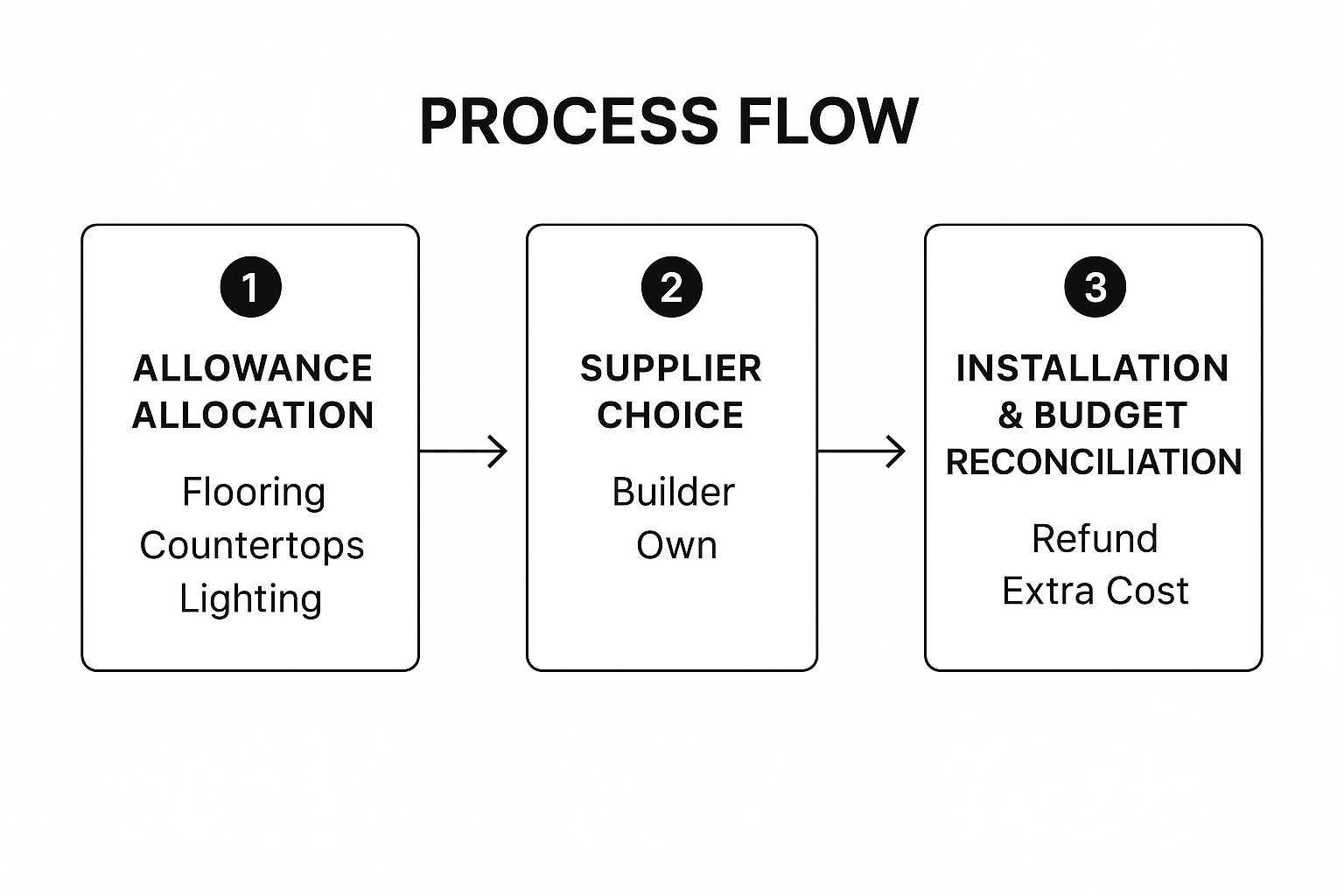
This process highlights how early decisions about allocations and suppliers directly influence your final budget reconciliation.
Actionable Tips for Clarity
To navigate allowances effectively and avoid unexpected costs, take these specific steps:
Request an Itemized Allowance Schedule: Get a written breakdown of the exact dollar amount for every category, including plumbing fixtures, flooring, lighting, countertops, and appliances.
Visit the Selection Center Early: Tour the builder's designated design center or showrooms to see what the standard allowance actually buys. This visual context is essential for budgeting upgrades.
Ask About Markup and Credits: Clarify the builder's markup percentage on any upgrades that exceed the allowance. Also, confirm in writing what happens to unused allowance money; is it a credit toward other upgrades, or a cash refund?
Negotiate Supplier Flexibility: Ask if you can purchase your own materials or fixtures for the builder to install. This can sometimes save money, but be aware that the builder may not warranty items they did not procure.
8. What is your process for handling changes, unexpected issues, and change orders?
No construction project goes exactly as planned, making this one of the most practical questions to ask a home builder. Changes initiated by you, like moving a wall, or unexpected issues, like hitting solid rock during excavation, are common. A builder’s process for managing these events, known as "change orders," reveals their professionalism, transparency, and ability to manage a project effectively. A clear, well-documented system protects both you and the builder from disputes over cost and time.
A change order is a formal document that amends the original contract, detailing the new work, its cost, and its impact on the project schedule. For example, deciding you want to add a kitchen island after the initial plans are finalized will trigger a change order. A reputable builder will provide a written estimate for the change, including materials, labor, and any administrative fees, for your approval before any work begins. Vague or verbal-only processes are a major red flag that can lead to significant budget overruns and conflict.
Actionable Tips for Clarity
To ensure a smooth process for any mid-build adjustments, take these proactive steps:
Request a Sample Change Order Form: Ask to see the document they use. It should clearly outline the scope of the change, the cost breakdown (materials, labor, markup), and the effect on the completion date. This gives you a preview of their documentation standards.
Understand the Fee Structure: Inquire about their markup percentage on materials and labor for changes. Some builders also charge a flat administrative fee per change order to cover the cost of processing the paperwork and coordinating with subcontractors.
Know the Cutoff Dates: There are critical points where changes become difficult or prohibitively expensive. Ask about deadlines for structural modifications versus cosmetic ones. It's crucial to understand these timelines before you look into modifying your house plan.
Clarify Responsibility for Unforeseen Issues: Discuss how costs are handled for unexpected site conditions (like poor soil or a high water table) or issues required to meet new building codes. A good contract will specify who bears this financial responsibility.
8 Key Questions to Ask Home Builders Comparison
Topic | Implementation Complexity | Resource Requirements | Expected Outcomes | Ideal Use Cases | Key Advantages |
|---|---|---|---|---|---|
What is included in the base price and what costs extra? | Low to moderate (clarifying pricing) | Requires detailed cost breakdown | Clear budgeting, fewer surprises | Budget planning, comparing builders | Accurate financial picture, prevents budget shock |
What is your construction timeline and what factors might delay completion? | Moderate (dependent on project scope) | Coordination of schedule, resources | Realistic schedule, helps plan move and financing | Move planning, contract scheduling | Reveals builder’s efficiency, aids planning |
What warranty coverage do you provide and what does it cover? | Moderate (warranty terms clarity) | Documentation, claims management | Financial protection, defect coverage | Protecting investment, ensuring builder accountability | Financial security, resale value enhancement |
Can I see examples of your previous work and speak with past clients? | Low (arranging visits, references) | Time for visits and interviews | Insight on quality and satisfaction | Verifying builder reputation | Unfiltered feedback, real-world quality evaluation |
Who will be my main point of contact and how often will we communicate? | Low to moderate (setting communication) | Requires dedicated personnel | Clear communication, fewer misunderstandings | Managing expectations, ongoing project updates | Builds trust, improves issue resolution |
What is your experience with local building codes, permits, and our specific lot conditions? | High (local expertise required) | Local knowledge, regulatory familiarity | Smooth permitting, fewer site issues | Building in specific jurisdictions | Efficient approvals, suitable construction methods |
What allowances do you provide for selections, and can I use my own suppliers? | Moderate (selection flexibility) | Supplier coordination, budget control | Greater control over finishes and costs | Personalizing finishes, budget management | Flexibility, prevents budget surprises |
What is your process for handling changes, unexpected issues, and change orders? | High (change management complexity) | Documentation, pricing, scheduling | Minimized disputes, controlled changes | Managing modifications, unexpected site conditions | Protects both parties, clear process reduces conflict |
From Questions to Keys: Taking the Next Step in Your Home Building Journey
Navigating the path to a new home is a significant undertaking, and the conversation you have with your potential builder is the very foundation of that journey. The comprehensive list of questions to ask your home builder provided in this guide is more than just a checklist; it's your strategic toolkit for uncovering the transparency, expertise, and compatibility of the professionals you're considering. Moving forward, your goal is to transform their answers into a clear, confident decision.
Remember, a builder’s response to your inquiries about base pricing, timelines, and warranty coverage reveals their commitment to financial clarity and client protection. Their willingness to share past projects and facilitate conversations with previous clients is a direct reflection of their pride and confidence in their work. A well-defined communication plan and a clear process for handling change orders are not just conveniences; they are the bedrock of a smooth, predictable, and low-stress building experience.
Synthesizing the Answers for a Confident Decision
Once you've gathered responses from several builders, it's time to compare. Don't just look at the bottom-line price. Instead, evaluate the holistic value each builder offers.
Transparency: Did one builder offer a more detailed breakdown of costs and allowances? A transparent builder minimizes the risk of surprise expenses down the road.
Process: Who had the most structured and reassuring process for managing delays, site issues, and client changes? A solid operational plan is crucial for staying on schedule and on budget.
Communication: Whose communication style felt most aligned with your own? Consistent, clear updates from a dedicated point of contact are invaluable for peace of mind.
Choosing the right builder is about finding a partner who not only has the technical skill to construct your home but also the integrity and professionalism to guide you through one of life’s biggest investments. The quality of their answers directly correlates to the quality of the home and the experience you can expect. By asking these critical questions, you empower yourself to select a builder who will not just build a house, but will help you realize your vision for a home.
Now that you're prepared to select the perfect building partner, the next step is finding the perfect blueprint. Explore the extensive portfolio of award-winning, construction-ready designs at RBA Home Plans. Our detailed plans provide the ideal foundation for your builder to bring your dream home to life. Visit RBA Home Plans to find a design that inspires your future.


Comments