
What Are Working Drawings: A Quick Guide (what are working drawings)
Updated: Dec 10, 2025
Ever tried to put together a complex piece of furniture without the instruction manual? You'd probably end up with a wobbly table and a pile of mystery screws. In the world of construction, working drawings are that all-important instruction manual, but for an entire building.
These are the highly detailed, technical documents that take an architect's beautiful design concept and translate it into a practical, buildable reality for the contractors on the ground.
The Blueprint for Building Success
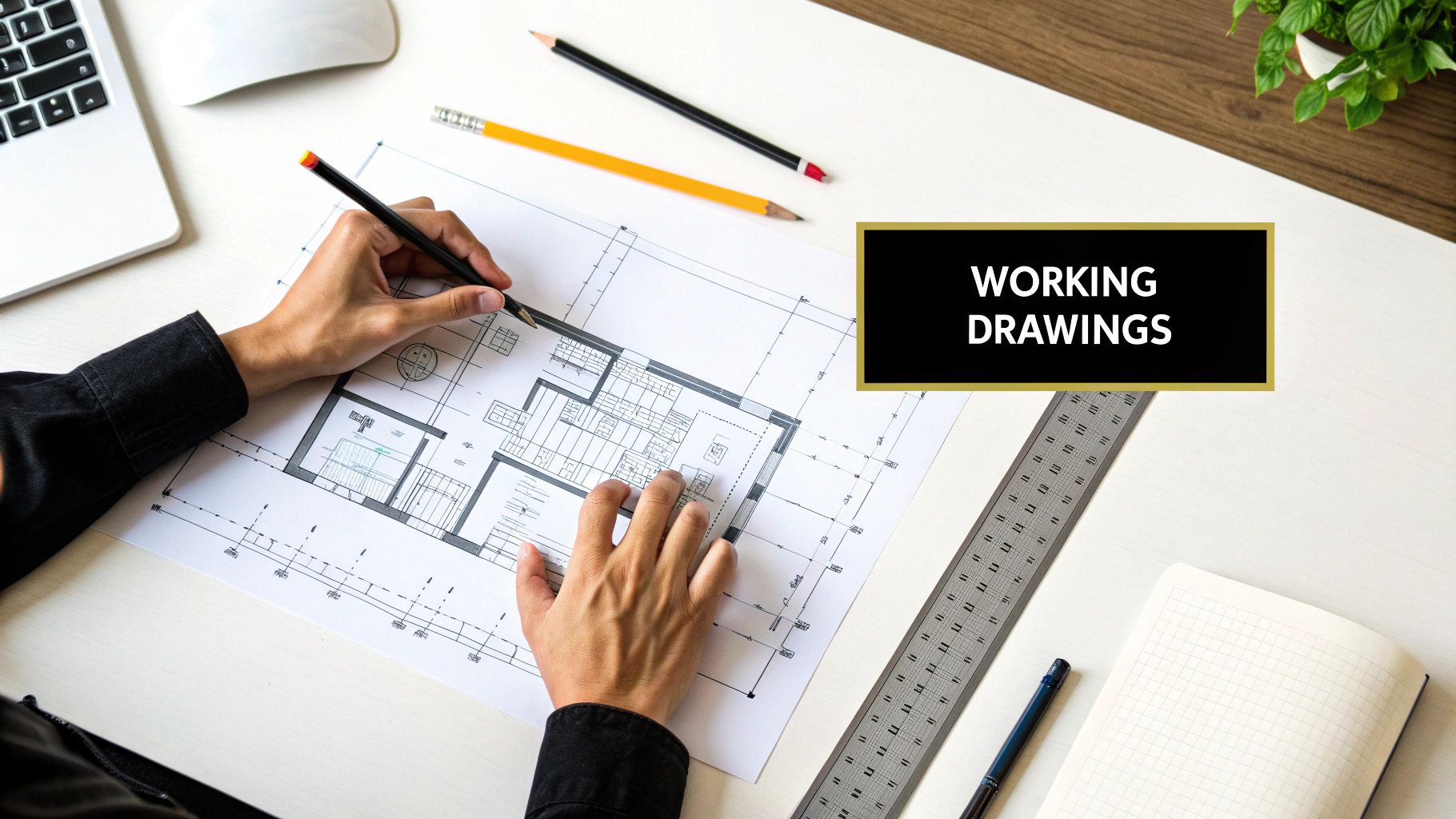
Think of working drawings less like a sketch and more like a complete, precise recipe for a building. While the first set of design drawings shows you the what—the overall aesthetic vision and how the spaces flow—working drawings get into the nitty-gritty of how. They strip away the artistic flourishes to provide a universal language that everyone, from the builders and electricians to the plumbers and engineers, can understand and execute perfectly.
These documents are the absolute backbone of any successful construction project. They’re not just helpful; they’re critical.
They Ensure Precision: Working drawings lay out the exact dimensions, specify every material, and detail all the assembly instructions. There's no room for guessing.
They Keep Everyone on the Same Page: They act as the single source of truth for every single professional involved in bringing the building to life.
They Keep Things Legal: These are the plans submitted to obtain building permits and demonstrate that the design meets all required safety codes and regulations.
They Stop Mistakes Before They Happen: By eliminating ambiguity, they drastically cut down the risk of expensive mistakes and rework on-site.
More Than Just Lines on Paper
Working drawings have come a long way, evolving from simple 2D projections on paper to the incredibly detailed documents needed by today's builders and manufacturers. Their primary role is to communicate precise construction requirements. They provide all the necessary graphical information, from structural layouts to electrical plans, making them essential for transforming a design into a physical structure. You can see great examples of their modern use over at bluentcad.com.
To put it simply, working drawings are the technical heart of a construction project. Let's break down their core purpose and characteristics.
Working Drawings at a Glance
Characteristic | Description |
|---|---|
Purpose | To provide a complete, graphical set of instructions for constructing a building. |
Audience | Contractors, builders, tradespeople (plumbers, electricians), engineers, and permit offices. |
Content | Dimensions, material specifications, assembly details, section views, electrical plans, etc. |
Focus | Technical precision and buildability, not artistic impression. |
Legal Standing | Forms a legally binding part of the construction contract. |
This table really highlights that these documents are all about clarity and execution, bridging the gap between the design studio and the job site.
A project without clear working drawings is a project destined for confusion, delays, and budget overruns. These plans are the critical link that ensures what was envisioned is what gets built, down to the last nail and wire.
Ultimately, these drawings become a legally binding part of the construction contract. They guarantee that every stakeholder—from the client paying the bills to the crew on-site—is aligned and working from the same exact playbook to achieve a single shared goal.
Decoding the Different Types of Working Drawings
A complete set of working drawings isn't just one big blueprint. It’s more like a library of specialized drawings, all carefully coordinated to tell the full story of your project. Think of an orchestra: each musician has their own sheet music, but all the parts must work in harmony to create the final performance.
This system is brilliantly organized. It ensures every professional, from the foundation crew to the electrician, gets exactly the information they need—without being distracted by details that aren't relevant to their job. The framer doesn't need to pore over the plumbing layout, and the plumber doesn't need to worry about structural beam calculations. That separation is what keeps a project running smoothly and efficiently.
Architectural Drawings: The Vision and Layout
Architectural drawings are the master plans. They're the ones that define the building's overall shape, size, and appearance. If you've ever looked at a house plan, this is likely what you saw. These drawings focus on how you'll experience the space once it's built.
They usually include a few key views:
Floor Plans: This is the classic top-down view of each level. It shows you the room layouts, dimensions, where doors and windows are located, and the thickness of the walls.
Elevations: These are the exterior views of the building from each side—north, south, east, and west. They detail the exterior finishes, rooflines, and window styles.
Sections: Imagine slicing the building in half like a cake. That's a section view. It reveals how all the different levels and components stack and connect with each other.
To get a feel for how detailed these can be, consider architectural detail drawings, which zoom in on complex connections, such as window installations. For a broader overview of these core documents, you can explore the main types of architectural drawings and see how they form the foundation of the project.
Structural Drawings: The Building’s Skeleton
While architectural plans show what the building looks like, structural drawings show how it stands up. These plans are created by a structural engineer and detail the building’s skeleton—all the load-bearing parts that guarantee its strength and stability.
This set of drawings is absolutely critical for the crews doing the heavy lifting. It includes foundation plans, framing layouts for floors and roofs, and all the specifications for materials such as concrete and steel. Without these, the building wouldn't be safe.
MEP Drawings: The Systems for Living
Finally, you have the MEP drawings. This set covers all the vital systems that make a building a comfortable place to live. The acronym stands for Mechanical, Electrical, and Plumbing.
MEP plans are the building's circulatory, nervous, and digestive systems. They detail everything from HVAC ductwork and outlet locations to water supply lines and waste pipes, ensuring the structure is a comfortable and functional space.
Each of these systems gets its own set of plans:
Mechanical: Shows the heating, ventilation, and air conditioning (HVAC) systems.
Electrical: Lays out all the wiring, outlets, light fixtures, and circuit breakers.
Plumbing: Details the water supply and drainage systems, from sinks to sewer lines.
Together, these different types of working drawings create a complete, interlocking instruction manual for your new home. Each set provides specialized information, but they are all cross-referenced to ensure everyone is on the same page for a seamless, conflict-free build.
Learning the Visual Language of Blueprints
To an untrained eye, a set of working drawings can look like a confusing jumble of lines, strange symbols, and random numbers. However, for construction professionals, this is a crystal-clear language that tells them exactly what to build, how to build it, and what materials to use.
Think of it like learning to read sheet music. At first, the notes and symbols on the page are just abstract marks. But once you understand the system, you can practically hear the symphony in your head. Learning to read blueprints is a lot like that—it allows you to see the finished building in the lines and symbols on the paper.
This visual language is built on three core components: lines, symbols, and scale. Get a handle on these, and you’ve unlocked the key to understanding any set of working drawings.
Understanding Lines and Symbols
On a drawing, not all lines are created equal. Different line types carry very specific meanings. A thick, solid line might represent a wall you can see, while a dashed line often points to a hidden feature, like a beam tucked away inside a ceiling or a property line.
These lines are the grammar of the drawing. They provide the structure for the symbols, which act as the vocabulary. To become truly fluent, it's essential to learn the fundamentals of reading house blueprints and understand how these elements tell a complete construction story.
Symbols are essentially standardized images that represent real-world objects. A simple arc shows you which way a door swings. A specific shape will indicate where an electrical outlet or a light fixture is located. Our comprehensive guide to common blueprint symbols is a valuable resource to help you become familiar with these essential elements.
The Importance of Scale
Scale is the brilliant concept that enables the fitting of an entire building onto a manageable sheet of paper. It’s simply the ratio between the size of something on the drawing and its actual size in the real world. A common scale you'll see in residential plans is ¼” = 1’-0”.
What this means is that every quarter-inch you measure on the drawing represents one full foot in reality. This ratio enables builders to use a special ruler called an architect's scale to extract precise measurements for any part of the house directly from the plans.
From an engineering perspective, working drawings serve as detailed blueprints that specify every necessary attribute to manufacture or construct a component precisely. They include multiple orthographic views along with exact dimensions, material specifications, tolerances, and assembly instructions, enabling rapid understanding by skilled workers. Discover more about the technical depth of engineering graphics on EngineeringTechnology.org.
Getting the scale right is non-negotiable. It’s what ensures every wall, window, and door is built to the correct size and fits together exactly as the designer intended.
How Drawings Guide a Project from Start to Finish
Long before a shovel hits the dirt, working drawings are already the backbone of a construction project. Think of them as the universal language that translates a complex design into a series of clear, actionable steps for everyone involved. Their journey doesn't start on the job site; it begins much earlier, in the bidding and contract stages.
Before a single nail is hammered, contractors pore over these detailed drawings to calculate the precise costs of materials and labor. This is what enables them to submit accurate and competitive bids. Once a contractor is chosen, the working drawings are written directly into the construction contract, making them legally binding documents that define the exact scope and quality of the work.
Securing Permits and Ensuring Safety
The next critical hurdle is getting the green light from regulators. Local building authorities require a full set of drawings for any permit application. Officials review these plans meticulously, checking that everything complies with local building codes, zoning laws, and safety regulations.
This review confirms the structural design is sound, the electrical systems are safe, and the plumbing meets public health standards. Construction can't legally begin without that official stamp of approval. The drawings serve as definitive proof that the proposed building will be safe for its future occupants.
Directing On-Site Construction
Finally, the working drawings arrive at the job site, where they become the daily playbook for every trade. The concrete crew uses the foundation plan to pour footings with absolute precision. Carpenters follow the framing plans to erect the building’s skeleton. Meanwhile, electricians and plumbers rely on their specialized MEP (Mechanical, Electrical, and Plumbing) drawings to ensure the correct installation of the building’s vital systems.
The ability to read these plans is a fundamental skill built on recognizing these core elements to understand the complete design.
These documents serve as the single source of truth, keeping the entire team coordinated and on the same page. They are the ultimate reference for quality control, allowing project managers to walk the site and verify that every component is installed exactly as specified. This level of detail is a crucial component of a comprehensive set of construction documents. If you want to see how these drawings fit into the bigger picture, our guide on what are construction documents explains it all.
The role of working drawings evolves as the project moves forward. Here’s a quick look at how their function changes from one phase to the next.
Function of Working Drawings Across Project Phases
Project Phase | Primary Use of Working Drawings |
|---|---|
Bidding & Negotiation | Used by contractors to estimate material, labor, and equipment costs for an accurate bid. Becomes part of the legal contract. |
Permitting & Approval | Submitted to local authorities to verify compliance with building codes, zoning laws, and safety regulations. |
Pre-Construction | Guides the procurement of materials and scheduling of subcontractors. Helps in detailed site planning and logistics. |
On-Site Construction | The primary instruction manual for all trades, detailing dimensions, materials, and installation methods. |
Quality Control & Inspection | Serves as the benchmark for project managers and inspectors to ensure work meets the specified standards. |
Project Handover | Forms the basis for "as-built" drawings, which document the final constructed state of the building for the owner. |
This table illustrates the central role these documents play, serving as a consistent and reliable thread that connects every stage of the process.
From securing financing and permits to guiding the final punch list, working drawings prevent costly disputes and ensure the finished structure perfectly matches the original architectural vision.
The Evolution from Hand Drafting to Digital Models
The way we create working drawings has undergone significant transformations over the years, keeping pace with the rapid advancements in technology. It wasn't that long ago that every architectural plan was a piece of art, painstakingly drawn by hand.
This era of manual drafting demanded incredible skill. Architects and drafters relied on tools like T-squares, compasses, and specialized pens to produce the iconic blueprints we picture when we think of classic construction. Every line was a deliberate stroke, and making a change was a slow, careful process of erasing and redrawing.
The level of detail in these hand-drawn sets was truly remarkable. Throughout the 19th and 20th centuries, architectural firms perfected the art, creating incredibly thorough drawing sets. You can see this artistry for yourself in archives like the Historic American Buildings Survey, which holds thousands of hand-drawn sheets documenting our most significant buildings. To get a feel for these historical records, you can learn more about architectural documentation at Syracuse University Libraries.
The Rise of Computer-Aided Design
The first real game-changer was the arrival of Computer-Aided Design (CAD). All at once, the drafting table moved to the computer screen. Ink and paper were replaced by pixels and vectors, and this digital jump brought a level of precision and speed that was simply out of reach by hand.
With CAD, architects could draw perfectly straight lines, create flawless curves, and duplicate elements with ease. The biggest win? Making changes became exponentially faster. Instead of erasing an entire section, a designer can simply edit, copy, or delete with a few clicks. This newfound speed opened the door to more complex designs and much faster project timelines.
CAD brought mathematical precision to the forefront of working drawings, allowing for complex geometries and effortless revisions. It standardized the process, making collaboration between different disciplines far more seamless than ever before.
Today’s Standard: Building Information Modeling
The latest and most profound shift is Building Information Modeling (BIM). While CAD creates 2D or 3D drawings, BIM creates intelligent, data-rich 3D models of the entire building. Think of it as building a digital twin of the structure before a single shovel hits the ground.
Every piece of a BIM model—from a wall to a window to a water pipe—is much more than just a shape. It’s an intelligent object loaded with layers of information:
Material specifications (like concrete strength or a window’s U-value)
Manufacturer details and specific model numbers
Cost information to keep the budget on track
Maintenance schedules for managing the building down the road
This smart model enables every team—architects, structural engineers, and MEP specialists—to work on the same central file simultaneously. The system can even spot clashes automatically, like a pipe running through a structural beam, flagging problems long before they become expensive mistakes on-site.
BIM has fundamentally changed what working drawings are, transforming them from static instructions into dynamic, data-driven guides for the entire project.
Common Questions About Working Drawings
Jumping into the world of construction and design can feel like you're learning a new language. You’ll hear a lot of terms thrown around that seem similar but actually have crucial differences. When it comes to what working drawings are, most people have the same questions right out of the gate. Let's clear up some common misconceptions.
Think of these documents as the lifeblood of any build. Getting a solid handle on them is key to understanding how a beautiful vision becomes a real, structurally sound building.
Working Drawings vs. Construction Drawings
One of the first questions we always get is, "What's the difference between 'working drawings' and 'construction drawings'?" Honestly, in day-to-day conversation, you'll hear people use them interchangeably. But there is a subtle, technical difference worth knowing.
Think of "construction drawings" as the complete legal package you hand over to the builder. It’s a comprehensive set that includes graphical plans, as well as written specifications, material schedules, and other critical contract documents.
"Working drawings," on the other hand, refer specifically to the graphical parts of that package—the detailed plans, elevations, sections, and details that show, visually, how to put the project together. In practice, though, if you ask for one, people will understand that you mean the complete set of plans required to build.
Who Creates Working Drawings?
Creating a comprehensive set of working drawings isn't a one-person task. It's a highly collaborative effort, almost always led by a principal architect or a lead design engineer who acts as the project's conductor.
It’s a team effort where each specialist adds their expertise to create a single, unified guide. Here’s how it usually unfolds:
The Architect starts by designing the overall building. They create the architectural drawings that define the layout, shape, and look of the structure.
Specialist Consultants are then brought in for the technical systems. Structural engineers provide the plans for the foundation and framing, making sure the building is strong and stable.
MEP Engineers (Mechanical, Electrical, and Plumbing) design and draw up the plans for the building’s essential systems, like HVAC, wiring, and water supply.
The lead architect is ultimately responsible for weaving all these specialized plans into one cohesive set of working drawings. This ensures a plumbing pipe doesn't accidentally end up where a structural beam is supposed to go.
The Legal Standing of Working Drawings
So, are working drawings legally binding? The answer is a definite yes. Once they are referenced in a signed contract between you and a contractor, these drawings become official, legally enforceable documents.
They serve a critical legal purpose by spelling out the exact scope and quality of the work. Any deviation from these drawings without a formal, written change order can be considered a breach of contract.
Working drawings are the bedrock of a construction agreement. They protect both the client and the contractor by creating a clear, unambiguous record of what is to be built, minimizing disputes and ensuring the final product meets all agreed-upon standards.
On top of that, these are the official documents reviewed and approved by local authorities to issue a building permit. That means the final construction must stick to them to be considered legally compliant and safe.
Design Drawings vs. Working Drawings
Another common point of confusion is the difference between design drawings and working drawings. The easiest way to think about it is to consider their purpose and when they appear in the project timeline.
Design drawings—like sketches, renderings, and conceptual plans—are created early on. Their main job is to communicate the artistic vision, explore ideas, and get your approval on the overall look and feel. They answer the question, "What will it look like?"
Working drawings come much later, after the design is finalized. They are highly technical, stripped of any artistic flair, and packed with the precise information needed for construction. They answer a completely different question: "How exactly do we build it?"
Aspect | Design Drawings | Working Drawings |
|---|---|---|
Purpose | To communicate the aesthetic vision and concept. | To provide technical instructions for construction. |
Audience | Primarily for the client to review and approve. | For contractors, builders, and tradespeople. |
Content | Artistic renderings, conceptual layouts, and mood boards. | Precise dimensions, material specs, and assembly notes. |
Timing | Created during the initial design phase. | Created after the design is finalized and approved. |
Ultimately, design drawings sell the dream. Working drawings provide the detailed, step-by-step manual to make that dream a reality. Both are essential, but they play very different roles in bringing a building to life.
At RBA Home Plans, we provide clear, comprehensive working drawings that serve as the perfect foundation for your building project. Our plans are designed for clarity and buildability, ensuring your builder has the exact information they need. Explore our collection of award-winning designs and find your perfect home plan at https://rbahomeplans.com.


Comments